Is Your Partner a Narcissist? Before You Jump to a Conclusion, Read This
The purpose of this article is to shed light on the complex and often destructive dynamics that develop in relationships when one partner is driven by pathological narcissistic patterns. People in such relationships often describe a state of constant emotional exhaustion, doubt, and loss of personal identity. In this insightful article, we will examine how the need for external validation turns emotional connection into a one-sided transaction, analyzing both the grandiose and vulnerable forms of narcissism in the context of the couple. In addition, we will clarify the clinical difference between the actual disorder and other dysfunctional attachment styles, while providing a full arsenal of practical advice, boundary-setting techniques, and ready-made phrases with concrete examples.
Emotional connection as a transaction
In a healthy and balanced relationship, love is expressed as a mutual process of care, emotional availability, and mutual acceptance of weaknesses — we have written extensively about how healthy foundations of a relationship are built. However, when narcissistic pathology enters the relationship, the emotional connection loses its authenticity and turns into a transactional dynamic. The partner is not treated as an autonomous personality with his or her own needs, but as an extension of the narcissistic person’s self — a tool that must provide attention, affirmation, and admiration (Day et al., 2022).
As long as one partner feeds the other’s self-image unhindered, the relationship may seem harmonious. However, the moment a partner demands their own space, expresses fatigue, or disagrees, the dynamic changes dramatically. The literature confirms that partners of individuals with a narcissistic structure systematically experience high rates of anxiety, depressive symptoms, and emotional disorganization (Day et al., 2022).
The Vulnerable Narcissist in Relationships: The "Victim" Trap
While the grandiose narcissist in a relationship is ostentatious, demanding, and overtly domineering, the vulnerable narcissist adopts a completely different, but equally manipulative, stance. He presents himself as the “permanently wronged,” the sensitive and misunderstood partner that no one has ever truly understood (Weinberg & Ronningstam, 2022).
At first, this vulnerability attracts highly empathetic partners, who take on the role of “healer” or “savior.” Gradually, however, it is revealed that the vulnerable narcissist maintains a hidden sense of entitlement intact. He demands absolute devotion, while he himself is incapable of providing emotional support. Every attempt by the partner to discuss his own needs turns into proof that “you are cruel too and hurt me like everyone else.”
Comparative Examples in Relationship:
1. Complaint scenario for lack of time/attention:
Grandiose Narcissist: “So you demand that I engage with you after all the hours I’ve been fighting outside? I bring the results to this relationship, if you want someone to hold your hand all day, find someone else.” Vulnerable Narcissist: “Isn’t everything I do enough for you? I always feel like I’m letting you down… I push myself all day and then I hear that I’m not trying hard enough. I guess I’m invisible to you.” (Shifts the focus from the partner’s complaint to their own “unfair” effort, causing guilt.)
2. Scenario of disagreement over a couple's decision:
Grandiose Narcissist: “The decision was made because I know what is right for us. Don’t try to tell me how to handle things.” Vulnerable Narcissist: “Are you attacking me again? When I disagree, you immediately portray me as the “bad guy” in the situation. No one respects my opinion in this house, I always give in.” (Reversing the roles of abuser and victim, making the partner apologize for simply expressing disagreement.)
3. Partner's personal success/joy scenario:
Grandiose Narcissist: “That’s all well and good, but if I hadn’t guided you and paved the way for you, you wouldn’t have accomplished any of this.” Vulnerable Narcissist: “I’m happy for you… It’s just that my day was a nightmare and I feel completely alone. But don’t ruin your mood for me, keep celebrating.” (Caps off the partner’s joy with passive-aggressive withdrawal, forcing them to stop the celebration to take care of him.)
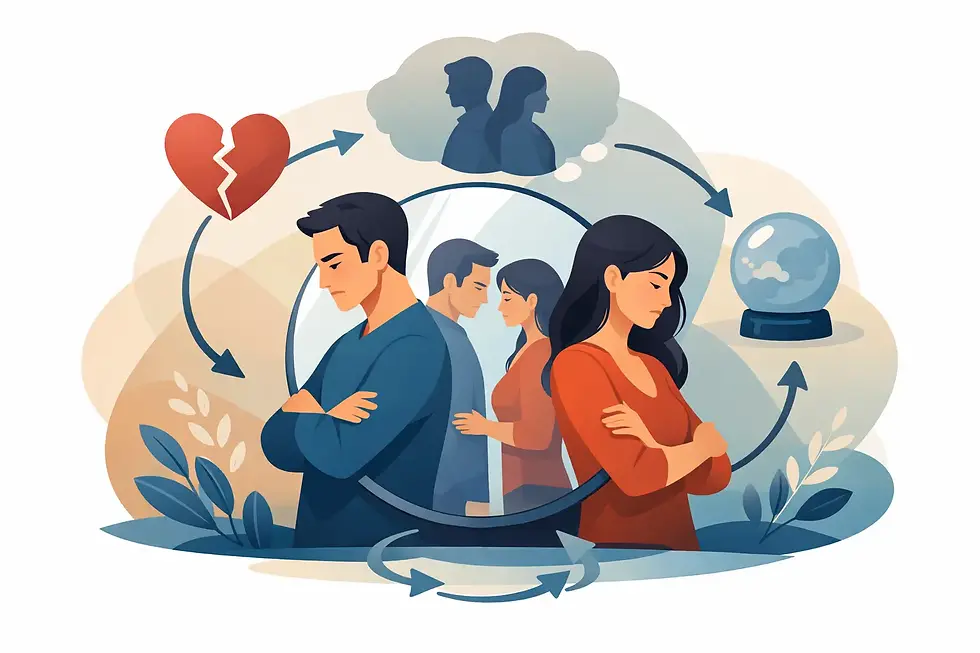
The 3-phase cycle of the narcissistic relationship
1. Love Bombing: A barrage of messages, excessive praise, quick commitment. You feel like you've found your perfect soulmate.
2. Gradual Devaluation Phase : Criticism, insults disguised as jokes, comparisons, and emotional distancing appear. The person begins to punish you for not being the “perfect” refuge for their ego.
3. Discarding or Abandoning Phase (Discard) & Hoovering When you are exhausted, the person either coldly rejects you or, if you try to leave, returns with dramatic promises of change (hoovering) to regain control, restarting the cycle (Caligor et al., 2015). These dynamics of control and entrapment in the relationship are also characteristically captured in literature; see our analysis in the article “What psychopathology does “The Cocoon” hide” .
“Is he really a narcissist?” – The clinical differentiation
In clinical practice, it is common to see women or men coming to therapy completely accusing their partners of being “narcissists.” However, thorough assessment often reveals that the partner does not meet the criteria for NCD. Often these are individuals with an avoidant attachment style, high work stress, depression, alexithymia, or simply profound emotional immaturity.
Hasty diagnostic labels prevent us from understanding the true dynamics of the couple. Distinguishing between a toxic but treatable communication dysfunction and a rigid narcissistic structure is fundamental to the decisions to be made. In such cases, a couples therapy session with a professional who will assess your dynamics without prejudice is often more helpful than seeking a definitive “label” for your partner.
If you recognize yourself in these lines and have already concluded that your partner “is a narcissist,” it’s worth a moment of consideration: An accurate description of specific behaviors—how they react when you express a need, whether there were moments of real connection, what the relationship was like in the beginning—helps much more than the label itself, both in your self-protection and in a potential healing process. The label offers a quick explanation, but it can hide other possible causes—avoidant attachment style, chronic conflict, burnout, depression—that require a different approach.
Practical survival and boundary setting guide (with examples)
1. Manage Gaslighting Categories with the BIFF Technique When your partner attempts to distort the facts, respond in a manner that is: Brief, Informative, Friendly, and Firm.
Example: Partner: “You never supported me at the dinner table yesterday, you left me alone to expose myself to your friends, you are unacceptable!” BIFF Response: “Yesterday I was present throughout the evening and participated in the conversation. If you feel upset, we can discuss it calmly tomorrow. Now I will rest.” (No apology, no confrontation).
2. Deconstruct the Vulnerable Narcissist's Guilt Don't take responsibility for their chronic emotional dissatisfaction. Ready-made Phrase: "I'm sorry you feel frustrated, but I can't take responsibility for your mood. I'm only willing to talk if we're both looking for solutions."
3. Set Safety “Red Lines” Define the consequences of violating your boundaries in advance. If you agree that demeaning someone stops the conversation, enforce it: get up and leave the room every time it happens, no exceptions.
Summary: Meaningful therapeutic change in your life doesn’t start with hoping your narcissistic partner will change, but with deciding to stop negotiating your personal dignity. If you recognize yourself in this article, you don’t have to deal with it alone — you can schedule an initial appointment and explore the dynamics of your relationship together.
BIBLIOGRAPHICAL REFERENCES
American Psychiatric Association. (2022). Diagnostic and statistical manual of mental disorders (5th ed., text rev.).
Caligor, E., Levy, KN, & Yeomans, FE (2015). Narcissistic personality disorder: Diagnostic and clinical challenges. American Journal of Psychiatry, 172(5), 415–422.
Day, NJS, Townsend, ML, & Grenyer, BFS (2022). Pathological narcissism: An analysis of interpersonal dysfunction within intimate relationships. Personality and Mental Health, 16(3), 204–216.
Ritter, K., Dziobek, I., Preißler, S., Rüter, A., Vater, A., Fydrich, T., Lammers, CH, Heekeren, HR, & Roepke, S. (2011). Lack of empathy in patients with narcissistic personality disorder. Psychiatry Research, 187(1-2), 241–247.
Weinberg, I., & Ronningstam, E. (2022). Narcissistic personality disorder: Progress in understanding and treatment. Focus, 20(4), 368–377.