Your jealousy doesn't lie, but maybe it's wrong?
If you recognize that tightness when your man laughs at someone else, takes a long time to answer, or keeps something to himself, you are not "excessive." Your jealousy does not lie - but it may blame the wrong person. The feeling usually shows that something inside you feels threatened, insecure, or afraid of loss. However, it does not prove in itself that the other person is cheating on you, that they do not respect you, or that the relationship is in danger. In this article, you will see how to separate the real feeling from the conclusions that accompany it, how to check the facts, and how to speak without turning fear into accusation.
Your jealousy doesn't lie, but what exactly is it saying?
Jealousy is a complex human emotion. It can include anxiety, anger, sadness, shame, and a desire for validation. It often occurs when something we consider important—our relationship, our exclusivity, our place in another person’s life—seems to be threatened. Research describes jealousy not as a single reaction, but as a combination of thoughts, feelings, and behaviors (Parrott, 1991).
So, jealousy is not fake. If you are hurting, the pain is real. The point to be careful about is the interpretation that follows: “Since I feel this way, it must be something.” This transition from feeling to conclusion happens quickly, especially when there is a previous experience of betrayal, rejection, or instability.
An unanswered text message can become “he’s ignoring me.” A warm conversation with a coworker can become “he’s flirting.” Your partner’s need for alone time can become “he doesn’t want me anymore.” The feeling is the bell. The story the mind writes around it needs to be checked.
The feeling is a given, the accusation is an assumption
Cognitive Behavioral Therapy (CBT) makes a useful distinction: the fact is one thing, the automatic thought is another, and the emotional reaction is another. This is not a play on words. It is a practical way to avoid decisions or conflicts based on incomplete evidence.
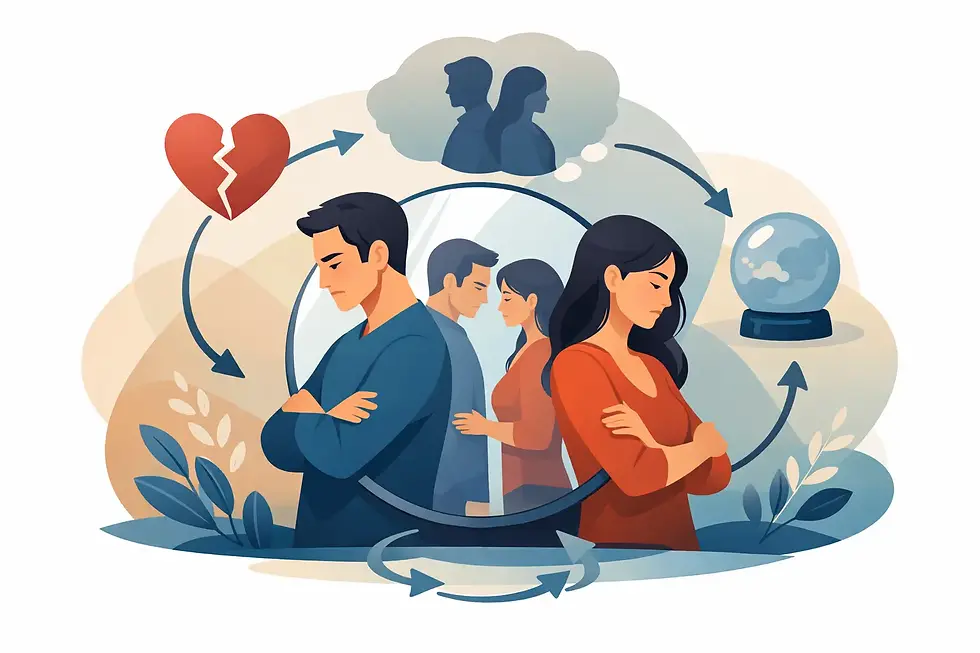
Let's take a common example. Fact: your partner looks at his phone and smiles. Automatic thought: "Someone is sending him something sexy." Feeling: jealousy and anger. Behavior: you push to see the phone, become abrupt, or withdraw. The fact may be accurate. But the thought remains an assumption until there is clear evidence.
This does not mean that you should ignore repeated inconsistencies, concealments, or breaches of agreements. Trust is not built on blind optimism. It is built when words and actions are consistent. The difference is that the investigation does not have to start with a verdict.
Why the mind often points to the wrong person
Sometimes the intensity of jealousy has more to do with old hurts than with your partner's current behavior. If you were cheated on in a previous relationship, your brain may have learned to detect threats early on. If you grew up with instability, criticism, or emotional distance, uncertainty in a relationship may trigger very strong fear.
Comparison also plays a big role. Jealousy can be directed at a “rival,” when in reality it touches on your own doubt: “Am I enough?”, “Will she find someone better?” Studies on romantic jealousy show that the perception of threat is influenced by both the characteristics of the relationship and personal insecurity and comparison (Buunk & Dijkstra, 2004).
It's not your fault that you have this sensitivity. But you are responsible for how you handle it. Constantly demanding proof, checking devices, questioning, or limiting the other person's contact may temporarily reduce anxiety. In the long run, it usually erodes trust and reinforces the vicious cycle of jealousy.
Before you speak, create space between the stimulus and the reaction.
When jealousy flares up, the goal isn't to convince yourself that "I shouldn't feel this way." The goal is to not let the emotion take over. A short pause can completely change the conversation.
Start by naming exactly what’s happening: “I feel jealous and afraid.” Then ask, “What are the observable data? What am I assuming? Is there a more balanced explanation?” Recording these three points, even for two minutes on your phone or on paper, helps reduce the merging of thought and reality.
You can also pay attention to your body. Rapid breathing, a tight chest, the need to immediately text or demand an answer are signs that you need to regulate before a dialogue. Try a few slow breaths, a short walk, or a time limit: “I will discuss this when I can listen, not just react.” This practice is linked to emotional regulation skills also used in DBT (Linehan, 2015).
How to express jealousy without attacking
The most useful communication doesn’t start with “Who sent you?” or “I know something is going on.” It starts with personal experience and a specific request. The difference isn’t just being nicer. It reduces defensiveness and increases the chances of hearing an honest response.
You can say, “When you abruptly left the conversation and didn’t respond for hours, I felt insecure. My mind went to worst-case scenarios. It would help if you told me what happened and agreed on how we would be notified if plans changed.” You’re not saying the other person is to blame. You’re saying what you noticed, how it affected you, and what you need.
Similarly, it is legitimate to listen to the other person's boundaries. Your need for transparency does not automatically mean a right to access every personal conversation or every moment. A healthy relationship needs both intimacy and privacy. Where the balance lies depends on the mutual agreements, the history of the relationship, and the consistency with which you adhere to them.
When does jealousy indicate a real problem?
There are cases where jealousy isn't based solely on fear. Repeated lies, secrecy that violates explicit agreements, belittling your feelings, or behaviors that make you systematically doubt your perception deserve serious attention.
The difference is in the pattern. A single incident can have many explanations. A consistent pattern of inconsistency needs clear discussion and boundaries. It is not therapeutic to convince yourself that everything is fine when the data shows otherwise. But neither is it therapeutic to turn every uncertainty into evidence of guilt.
When the cycle repeats
If the same conflicts keep coming back, if jealousy is draining you, or if the relationship has become a place of control and defense, individual or couples therapy can provide a safer framework for exploration. The work isn’t about “making jealousy go away.” It’s about understanding what it’s trying to protect, changing the thoughts that fuel it, and building behaviors that support trust.
CBT focuses specifically on how interpretations influence our feelings and actions (Beck, 2020). When you learn to identify the automatic story before it becomes a category, you create space for choice. And choice is where a relationship begins to change.
A fairer question
The next time jealousy arises, you may not need to ask first, “Whose fault is it?” Try asking, “What am I afraid of losing and what do I need to feel safe without hurting the other person?” The answer may not be easy, but it is often more honest. And from that honesty can begin a conversation with less fear and more connection.
Bibliographic references
Beck, JS (2020). Cognitive behavior therapy: Basics and beyond (3rd ed.). Guilford Press.
Buunk, BP, & Dijkstra, P. (2004). Gender differences in rival characteristics that evoke jealousy in response to emotional versus sexual infidelity. Journal of Social and Personal Relationships, 21 (3), 395-410.
Linehan, MM (2015). DBT skills training manual (2nd ed.). Guilford Press.
Parrott, WG (1991). The emotional experiences of envy and jealousy. In P. Salovey (Ed.), The psychology of jealousy and envy (pp. 3-30). Guilford Press.