When Does Couples Therapy in Athens Help?
When a conversation about everyday matters keeps ending in silence, defensiveness, or tension, the problem usually isn't just the topic at hand. It's the way the couple has learned to approach disagreement, disappointment, and the need for closeness. Couples therapy in Athens offers a safe, structured space where you can understand what's happening between you without needing to prove who's right. This article aims to help you recognize when therapy can be useful, what happens in sessions, and how to apply the process to your everyday life.
When a Couple Needs Help
A major crisis doesn't have to come first for a couple to turn to therapy. Often, distance builds quietly: less meaningful conversation, more criticism, avoidance of difficult topics, or a sense that the two of you function more like co-managers of life's logistics than as partners.
Sometimes there's a specific trigger, such as infidelity, recurring conflicts over finances, parenting, or the relationship with families of origin. Other times, the difficulty is tied to exhausting work schedules, commuting, demanding positions of responsibility, or the persistent feeling that there's no room left for the relationship. For Greeks living abroad, distance from a familiar environment and different life rhythms can also put pressure on the couple's connection.
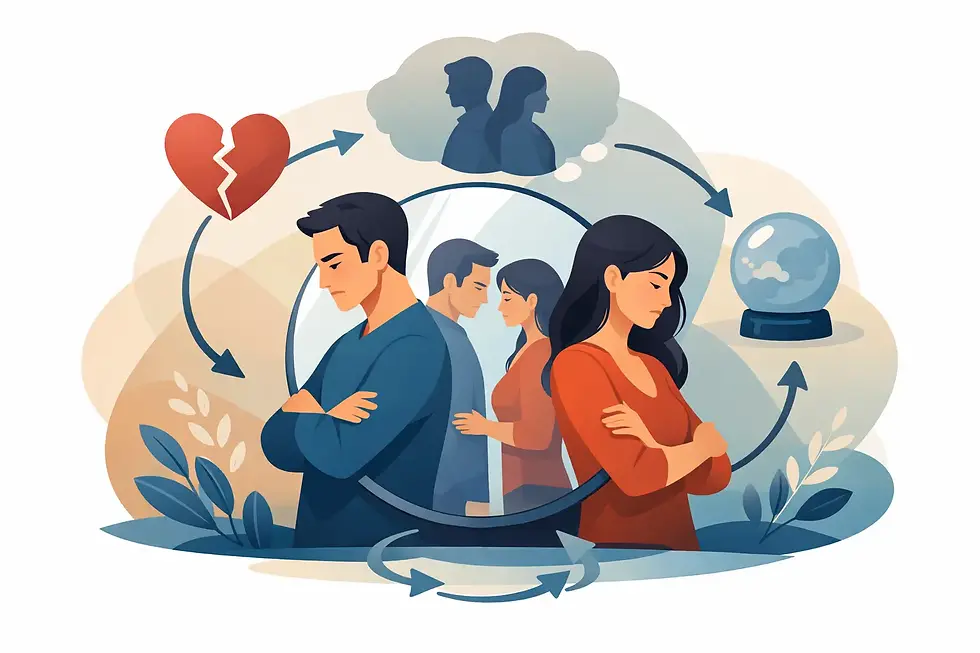
One useful sign is this: even though you love or care about each other, your attempts to solve the problem often make it bigger. One pushes for conversation, the other withdraws. One expresses a complaint, the other hears an accusation. This cycle — not either person's character — is usually where the therapy needs to focus.
What Couples Therapy in Athens Does Differently
Couples therapy isn't an arbitration process. The therapist doesn't decide who's right, nor ask one partner to change to satisfy the other. It helps the couple notice the pattern that's trapping them and find a more functional way to express needs, boundaries, fears, and desires.
In the first sessions, the relationship's history, significant changes that have occurred, sources of tension, and what still connects the couple are explored. This assessment isn't done to put a label on the relationship — it's done so that goals are clear and realistic: for example, reducing explosive conflicts, restoring trust, or reaching a shared decision without ultimatums and prolonged uncertainty.
Research shows that couples therapy approaches can meaningfully improve both the relationship and the partners' psychological wellbeing, particularly when both partners are actively engaged (Lebow et al., 2012). This doesn't mean every relationship will continue in the same form. In some cases, the most honest and protective outcome is clarifying what can and can't change. Therapy can support this exploration too, with respect.
From Accusation to Need
Behind the phrase "you're never here" there may be a need for more attention and connection. Behind "you're suffocating me" there may be a fear that there's no room for personal autonomy. When these deeper needs aren't spoken clearly, the conversation fills up with accusations, defensiveness, and interpretations of the other's intentions.
Therapeutic work helps change the language of conflict. Instead of "you don't care about anything," it can become "when you pull away after a disagreement, I'm afraid of being left alone with the problem." This shift doesn't automatically resolve the disagreement — but it creates the conditions for the other person to be heard without needing to defend themselves.
What a Session Looks Like in Practice
In a session, a recent incident is often examined in some detail — not to relive the tension, but to reveal the sequence: what was said, how it was interpreted, what emotion appeared, and what reaction followed. Through this process, partners start to see the vicious cycle before it sweeps them up.
Small exercises for home may be given, such as a short daily conversation time without phones and practical to-dos, or an agreement to pause when tension rises too much. A pause isn't abandoning the conversation — it only works when paired with a specific commitment to return to the topic, for example after half an hour or that same evening.
An effective conversation doesn't require agreeing on everything. It requires being able to disagree without contempt, belittling, or a walkout that leaves the other person stuck. Research by Gottman and Gottman (2015) highlights the importance of a gentle start to a difficult conversation, acknowledging the other's perspective, and efforts to de-escalate when tension rises.
What You Can Do Before and Between Sessions
Progress doesn't depend on never fighting. It depends on whether you can gradually return to connection with greater safety. Before opening a difficult topic, it helps to ask yourself: "What do I actually need the other person to understand?" and "How can I say this without immediately putting them on the defensive?"
Pay attention to timing too. A serious conversation late at night, after a stressful day, or in front of the children is less likely to lead to resolution. This isn't about avoidance — it's a mature choice about context. If one partner needs a little time to calm down, that need deserves respect, as long as it doesn't turn into permanent silence.
Emotional closeness is also reinforced by small, consistent acts: a question asked with genuine interest, a thank-you for something specific, a calm touch, acknowledging a hard day. These gestures don't replace discussing the bigger issues — but they create safer ground for that discussion to happen.
Common Questions Before Starting
Do we both have to want the same thing?
Ideally, both partners recognize that there's a difficulty worth attention. But they don't need to share the same interpretation or the same level of readiness. It's enough to have a minimal willingness to hear the other's experience and examine the shared pattern.
How long does the process take?
There's no single answer. It depends on how long-standing the problem is, the level of trust, external pressures, and how well what's discussed gets applied between sessions. Some couples need focused work on a specific issue, while others benefit from a longer process because the difficulties are older and more layered.
Can it help after a serious rupture?
Yes, provided there's honesty and a willingness to take responsibility for what happened. Rebuilding trust isn't based on in-the-moment reassurances but on consistency, transparency, and time. Emotionally focused couples therapy places particular emphasis on restoring a secure emotional bond between partners (Johnson, 2019).
Seeking help isn't an admission of failure. It can be a calm, mature decision not to keep hurting each other in ways neither of you wants. If the relationship still holds value for you, change often begins with a more honest conversation and the willingness to have it differently.
References
Gottman, J. M., & Gottman, J. S. (2015). 10 principles for doing effective couples therapy. W. W. Norton & Company.
Johnson, S. M. (2019). Attachment theory in practice: Emotionally focused therapy (EFT) with individuals, couples, and families. Guilford Press.
Lebow, J. L., Chambers, A. L., Christensen, A., & Johnson, S. M. (2012). Research on the treatment of couple distress. Journal of Marital and Family Therapy, 38(1), 145-168