The quiet burnout that is not visible
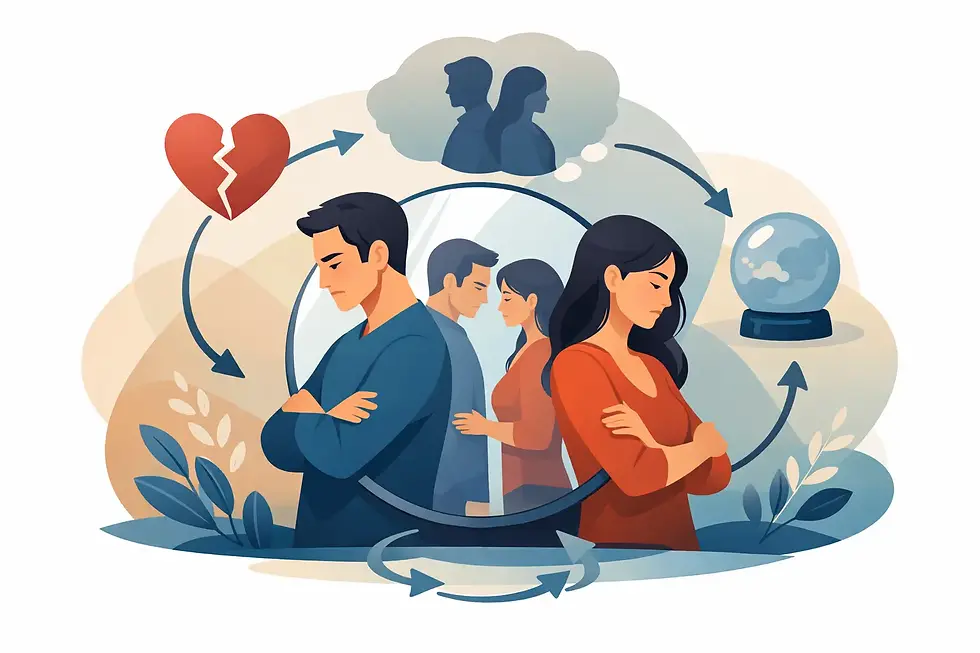
There are people who continue to function normally, go to work, answer messages, take care of others, and yet, inside, they feel increasingly empty. This is often the "quiet burnout" that is not visible - how it destroys you without you realizing it. It does not always have intense explosions, nor a spectacular collapse. It is more like a slow deterioration that goes unnoticed, even by you. In this article you will see what it is, how it appears in everyday life, why it is often confused with simple fatigue or a "bad phase", and what small but essential steps can help you recognize it in time and protect your mental balance.
What is the "quiet burnout" that is not visible?
When we hear the word burnout, many people imagine a person who has reached their limits and can no longer get out of bed. In practice, however, burnout does not always manifest itself so clearly. You can be productive, consistent and seemingly "fine", but you are only functioning out of habit and duty.
The scientific literature describes burnout as a state of emotional exhaustion, detachment, and a diminished sense of efficacy, primarily in relation to work, but often also in relation to other demanding life roles (Maslach & Leiter, 2016). “Quiet” burnout is not an official diagnostic term. It is a useful way to describe the exhaustion that is masked behind functionality, politeness, and constant self-control.
Simply put, you are not absent from your life. You are present, but less and less alive in it.
Why does it go so easily unnoticed?
The problem with this form of burnout is that it is often rewarded. The person who "holds on", who doesn't complain, who gets by and doesn't burden anyone, is considered mature and strong. But many times what appears to be endurance is actually a disconnection from their needs.
Especially in people with a high sense of responsibility, perfectionism, or a strong need not to disappoint others, burnout hides behind the phrase “it’s okay, I’ll do this too.” Chronic pressure, lack of meaningful rest, and the feeling of constantly having to respond create a background where wear and tear occurs slowly and silently.
Research shows that long-term work pressure without adequate recovery is associated with a burden not only on mood, but also on cognitive function, sleep, and relationships (Salvagioni et al., 2017). This means that we are not talking about a simple phase of fatigue. We are talking about a condition that gradually penetrates everywhere.
Signs aren't always spectacular
Often the first sign is not weakness, but loss of interest. You do what you should, but you feel almost nothing. You used to be satisfied with being effective. Now you just execute. You used to enjoy the little moments. Now everything seems flat.
You may also notice that you are constantly tired, but not necessarily sleepy. It is a deeper fatigue, as if your energy is never replenished. Even after a weekend or a few days off, you don't feel truly recharged.
Other people experience it as irritability for no apparent reason. Little things tire you out excessively. A message, an obligation, a simple conversation seem disproportionately heavy to you. Sometimes a colder attitude towards others appears, not because you don't care about them, but because you don't have mental space.
It's also common to feel like you're operating on autopilot. You forget easily, have trouble concentrating, and put off things you used to do effortlessly. Chronic burnout affects not only your mood, but also your mental performance.
How it destroys you without you realizing it
The word "destroys" sounds heavy, but in this case it describes an underlying loss. You don't necessarily lose everything all at once. You gradually lose your connection with yourself.
First, your ability to feel wears out. Not just joy, but also outright discontent. You live in a murky zone where nothing is quite right, but nothing is bad enough to call for help. That's what makes "quiet burnout" so deceptive.
Then relationships are affected. When you are constantly mentally exhausted, you find it difficult to be available. You may withdraw, respond mechanically, or feel that every emotional demand is an extra burden. People close to you may perceive this as indifference, when in reality it is exhaustion.
Then, self-esteem often erodes. Because you're still functioning, you expect yourself to perform as well as you used to. When that doesn't happen, you don't say, "I'm exhausted." You say, "There's something wrong with me." This internal misinterpretation adds to the shame.
Burnout is also associated with an increased risk of anxiety symptoms and depressive symptoms, especially when the person is left for a long time without support or changes in their life demands (Koutsimani et al., 2019). This does not mean that all fatigue leads to burnout. However, it does mean that prolonged drain has a cost.
When is it not just tiredness?
Simple fatigue usually improves with rest, sleep, a clear break. Burnout, even in its most “quiet” form, does not subside so easily. If you feel like you are resting but not recovering, you need to take it more seriously.
Also, fatigue doesn't always change the way you see the world. Burnout does. You start to experience responsibilities you previously managed as unbearable, people you love as demanding, and yourself as inadequate. This change in filter is an important sign.
Of course, there's also the "it depends." Sometimes the picture of burnout is tied to a specific period of increased demands—a move, a difficult relationship, a job strain. Other times it reveals a more chronic pattern, where you've been putting everyone else's needs above your own for years. The difference matters, because it also affects the kind of help you need.
What can you do before you reach your limits?
The first step is to stop measuring only your functionality. Just because you're getting by doesn't mean you're okay. Ask yourself something more substantial: how do I feel about the life I'm holding up?
Then, try to notice exactly where your energy is being wasted. Not everyone is equally tiring. For someone, it's the constant availability at work. For another, it's taking care of everyone without any counterweight. For another, the internal pressure to be constantly sufficient. The more specifically you see it, the more realistically you can intervene.
It is useful to take small, not spectacular, breaks. Not just “rest when I collapse”, but constant decompression points throughout the week. This does not solve the problem in itself, but it helps the nervous system to come out of permanent alert. Recovery is not a luxury. It is a prerequisite for continuing without emptying.
In many cases, a more honest look at your limits is needed. If you say yes when you really want to say no, if you constantly take on more because you have difficulty withstanding the disappointment of others, then the issue is not just the burden. It's also the way you've learned to relate to demands.
Psychotherapy can be of great help at this point. Not just to “rest,” but to understand why you are exhausted the way you are, what patterns are keeping you there, and how you can build a more sustainable daily life. For people living in the fast-paced city of Athens or for Greeks abroad who are juggling multiple roles at once, this exploration is often particularly comforting.
When is it worth asking for help?
If you feel like you've stopped recognizing yourself, if the disconnection lasts for weeks or months, if your relationships are deteriorating and everyday life seems increasingly difficult, you don't need to wait for it to "get bad enough." This is one of the most common mistakes people with quiet burnout make. Because they're still enduring, they believe they don't deserve help.
You deserve it long before you reach a complete breakdown. In fact, it is usually more effective then. Early recognition is associated with better recovery, because the cycle of exhaustion and alienation from oneself is not so deeply entrenched (World Health Organization, 2019).
You don't need to prove that you're suffering "enough." It's enough that something inside you is starting to fade.
References
Koutsimani, P., Montgomery, A., & Georganta, K. (2019). The relationship between burnout, depression, and anxiety: A systematic review and meta-analysis. Frontiers in Psychology, 10, 284.
Maslach, C., & Leiter, MP (2016). Understanding the burnout experience: Recent research and its implications for psychiatry. World Psychiatry, 15(2), 103-111.
Salvagioni, DAJ, Melanda, FN, Mesas, AE, González, AD, Gabani, FL, & de Andrade, SM (2017). Physical, psychological and occupational consequences of job burnout: A systematic review of prospective studies. PLoS ONE, 12(10), e0185781.
World Health Organisation. (2019). Burn-out an occupational phenomenon: International Classification of Diseases 11th Revision (ICD-11).
Sometimes the most serious burnout doesn't make a sound. It just makes you get used to a life that drains you. And that, in itself, is reason enough to be a little more careful with yourself.