The Nature of Emotions: Anger and Shame
A sharp reply in a meeting, the silence that follows an argument, or the intense urge to hide after a mistake might seem like unrelated reactions. Often, though, they're connected to two very human emotions. The nature of emotions — anger and shame — is about not only what we feel, but also how we protect ourselves, our relationships, and our self-image. This article aims to explain, in plain language, what anger and shame are "saying," how they interact, and how you can manage them without suppressing them or letting them dictate your choices.
The nature of emotions: anger and shame
Emotions aren't enemies that need to be eliminated. They're signals: they organize our attention, prepare us for action, and inform us about what matters to us. This doesn't mean every emotional reaction is accurate or useful. It does mean, though, that it's worth listening to before deciding how to act.
Anger typically arises when we perceive injustice, a boundary violation, being belittled, or an obstacle to an important goal. It can bring energy and resolve — helping you say "no," stand up for fair treatment, or set a limit. The difficulty starts when the intensity of anger leads to insults, threats, impulsive decisions, or prolonged withdrawal.
Shame is different from guilt. Guilt says, "I did something I don't like." Shame often says, "something is wrong with me." That's why it can weigh so heavily: it doesn't focus only on an act, but touches your sense of worth and acceptance. Research by Tangney and colleagues shows that guilt is more often linked to reparative actions, while shame can bring withdrawal, defensiveness, or attack (Tangney et al., 2007).
When anger is hiding shame
It's not uncommon for someone to express anger at the very moment they, more deeply, feel shame. A manager points out a mistake, and the first reaction is aggressive denial. A partner says they feel neglected, and the other responds with sarcasm. Beneath the irritation there may be the painful thought "I'm not enough," "I've been exposed," or "they're going to reject me."
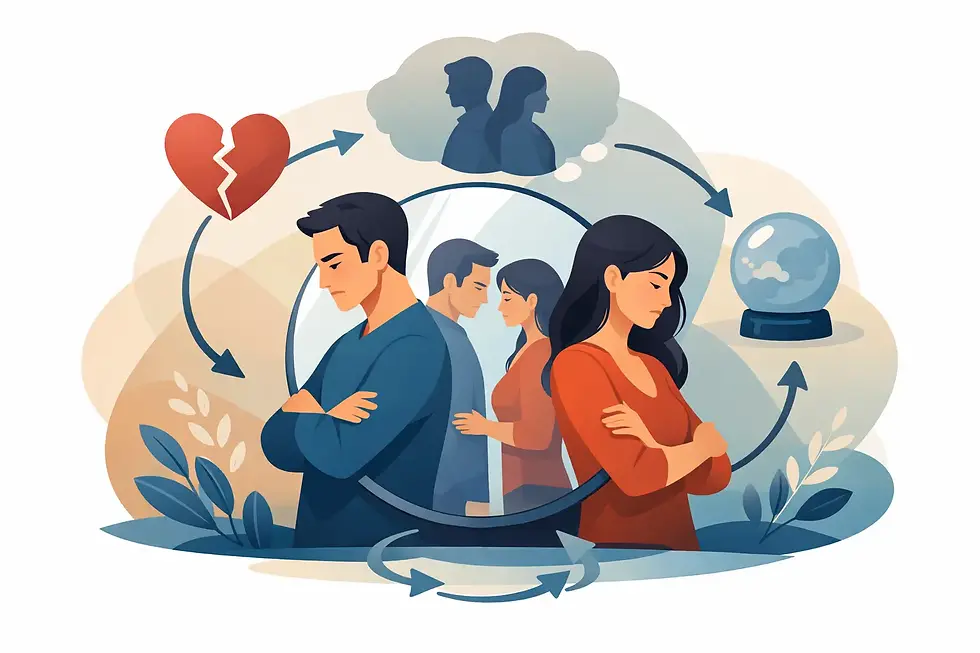
Anger then acts as a protective cover. It's often easier to blame the other person than to admit you've been hurt. This defense brings temporary relief, but it comes at a cost: the other person hears an attack, not the vulnerability underneath it. This creates a cycle in which shame breeds anger, anger strains the relationship, and the strain feeds new shame.
This doesn't mean every instance of anger is hiding shame. Sometimes anger is a clear, reasonable reaction to poor treatment or a systematic violation of boundaries. The point is to explore what else may be present: fear, disappointment, a sense of injustice, loneliness, or exposure.
At work: the threat of being evaluated
In demanding work environments, shame can be strongly triggered when performance, competence, or standing seem to be judged publicly. A comment in a meeting, a correction from a superior, or a comparison with a colleague can be interpreted as personal devaluation, even when that wasn't the intention.
It helps here to take a brief pause before responding. Ask yourself: "What exactly happened? What interpretation am I giving it? What do I need right now?" You might need clarification, time, or a more specific form of feedback. A steady phrase like "I want to understand the comment and see what I can improve" protects both your dignity and the working relationship.
In relationships: from attack to request
In close relationships, anger often shows up as generalizations: "You never think of me," "You always put me down." Behind these phrases there's usually a real request, but it's hidden. When shame is present, it can be hard to say "I felt insignificant" or "I was afraid you didn't want me."
The change doesn't require speaking perfectly in the heat of the moment. It requires shifting, when possible, from accusation to description. For example: "When you changed our plans without telling me, I got angry. Underneath that, I felt like I don't matter to you. I'd like us to talk about it earlier next time." This kind of phrasing doesn't guarantee the other person will respond ideally. But it increases the chances that the need gets heard instead of the conflict escalating.
Practical management in the heat of the moment
Managing anger and shame isn't a matter of self-control in the narrow sense. It's a skill of recognition, regulation, and choice. Cognitive-behavioral approaches place particular emphasis on the connection between the event, the interpretation, the emotion, and the behavior (Beck, 2020).
Start with the body. Notice the early signs: tightness in the chest, tension in the jaw, a raised voice, the urge to walk away or send a sharp message. A few slow exhales and a brief step back from the conversation aren't avoidance when they come with an intention to return: "I need twenty minutes to calm down, and I want to continue after that."
Next, name precisely what you're feeling. Instead of "I feel awful," try: "I feel exposed," "I feel wronged," "I'm afraid I failed." Naming it often reduces confusion and gives you more options. Research on emotion regulation emphasizes that the strategy that helps depends on the context, the intensity, and the goal of the moment (Gross, 2015).
Finally, separate the fact from the conclusion. The fact might be "my colleague made a remark in front of others." The conclusion might be "they think I'm incompetent." The first is observable. The second may or may not be accurate. This distinction doesn't cancel out the emotion, but it limits the chance of reacting to an assumption as if it were a certainty.
When more support is needed
It's worth seeking psychotherapeutic support when anger repeatedly leads to ruptures, when shame isolates you, or when you avoid opportunities, conversations, and relationships out of fear of exposure. The same applies when, after conflicts, you stay in self-criticism for hours or days, unable to find your way back.
Therapeutic work isn't aimed at making you less assertive or less sensitive. It aims to help you recognize the need underneath the tension, evaluate the thoughts that intensify it, and choose responses closer to your values. Self-compassion, for example, isn't leniency without limits. It's a way of facing a mistake without turning a single event into proof of personal inadequacy (Neff, 2003).
Anger and shame don't have to become the drivers of your life. They can become the starting point for a more honest question: "What am I trying to protect right now, and how can I express it without hurting myself or the other person?" Even one small, calmer response can change the next conversation — and gradually, the way you stand in relation to yourself.
References
Beck, J. S. (2020). Cognitive behavior therapy: Basics and beyond (3rd ed.). Guilford Press.
Gross, J. J. (2015). Emotion regulation: Current status and future prospects. Psychological Inquiry, 26(1), 1-26.
Neff, K. D. (2003). Self-compassion: An alternative conceptualization of a healthy attitude toward oneself. Self and Identity, 2(2), 85-101.
Tangney, J. P., Stuewig, J., & Mashek, D. J. (2007). Moral emotions and moral behavior. Annual Review of Psychology, 58, 345-372.