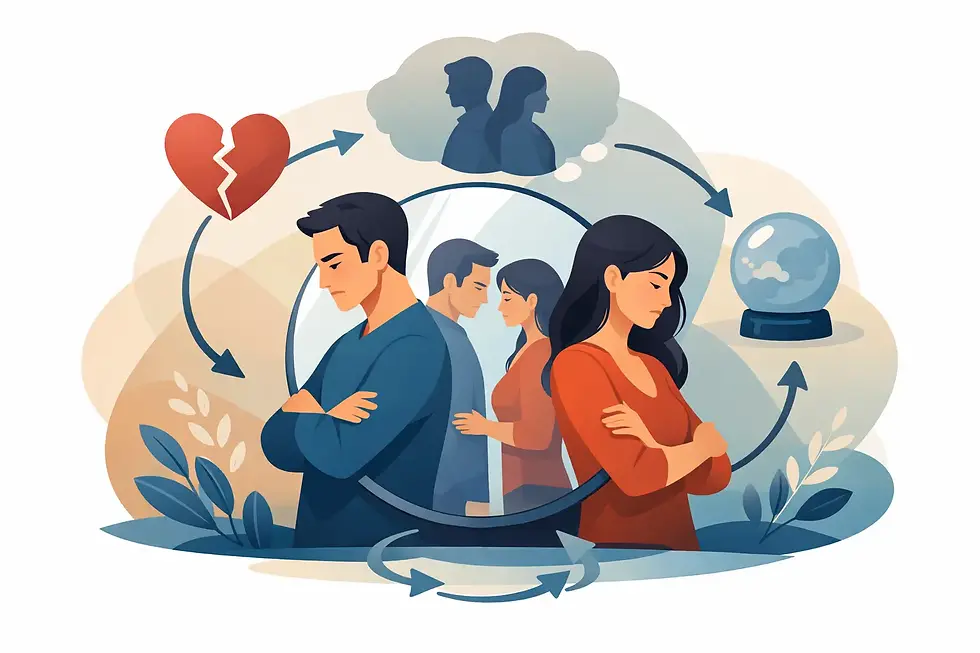
The control trap: why doesn't jealousy protect you from what you fear?
If you find yourself wanting to check a message, an outing, or who liked a post, you probably don't want to limit your man. You want to feel safe. That's where the control trap lies: why jealousy doesn't protect your relationship, and what does it actually do? It offers a momentary relief from uncertainty, but often cultivates more fear, tension, and distance. In this article, you'll see how this cycle is created, when jealousy is a helpful signal and when it turns into a burdensome pattern, as well as how you can react with more composure and clarity.
The control trap: why jealousy doesn't protect
Jealousy is a human emotion. It can occur when you fear losing your place in the life of an important person, when you compare yourself to someone else, or when a behavior from your partner triggers old insecurities. The emotion itself does not prove that there is a problem in the relationship - nor that you are "unreasonable" or "excessive."
The problem begins when jealousy automatically translates into control: repeated questions, demands for reassurance, cell phone checking, social media monitoring, pressure to limit friends or activities. Then the goal is no longer to communicate a need, but to eliminate all uncertainty. And no relationship can offer such certainty.
Control provides temporary relief, but it trains fear.
From a CBT perspective, the cycle is understandable. A thought emerges, such as “If he doesn’t answer, something is wrong” or “If he goes out without me, maybe he’ll meet someone better.” Anxiety, anger, or sadness follows. Control—a message, a question, a search for clues—temporarily reduces the tension.
This temporary relief makes control seem effective. But in the long run, the mind learns that uncertainty is dangerous and that constant surveillance is needed to withstand the emotion. Thus, the threshold for anxiety is lowered: what went unnoticed yesterday may seem suspicious today.
Research on romantic jealousy suggests that how one handles the emotion affects the relationship more than the emotion itself. Accusations, surveillance, and avoidance tend to escalate conflict, while more direct and vulnerable communication creates better conditions for connection (Guerrero et al., 1995).
What control really does to a relationship
Control is often presented as interest: “If I don’t ask, it means I don’t care.” In practice, however, interest allows for autonomy, while control requires the other person to constantly prove that they won’t hurt you. The difference is fundamental.
First, trust is eroded. When one person constantly needs proof and the other feels interrogated, the relationship shifts from cooperation to defense. Even if there is no actual breach of trust, the message is: “I don’t trust you until you prove it to me again.”
Then, intimacy diminishes. True intimacy requires the freedom to share thoughts, mistakes, and doubts without fear of them being used against you. When any information can become a reason for a fight, your partner may start to avoid conversations or keep things to themselves. This can be perceived as confirmation of suspicion, while it is often a reaction to pressure.
Finally, control creates an unequal dynamic. One person becomes the evaluator and the other the controlled. Over time, both lose: the controller never truly calms down, and the controlled person loses the sense of being respected. Studies on behavior regulation in close relationships link pushy and critical strategies to higher tension and lower relationship satisfaction (Overall et al., 2009).
When is jealousy a signal and when does it become a pattern?
It's not helpful to tell yourself that you should "never be jealous." There are times when jealousy indicates that something needs to be discussed: inconsistency between words and actions, secrecy, violation of a couple agreement, or flirting that goes beyond the boundaries you've set. In these cases, the solution is not to ignore your instincts. It's to examine them with facts and speak clearly.
The difference lies in whether you are relying on observable data or assumptions. It is one thing to say: “We had agreed that you would tell me that you would be late and you didn’t. That made me feel uncomfortable.” It is another to say: “You didn’t answer for an hour, so you must be kidding me.” In the first case, you are describing an incident and a need. In the second, the thought is presented as a fact.
Experiences of past rejection, infidelity, or instability can make the mind more sensitive to potential threats. This doesn’t mean you’re doomed to repeat the same pattern. It just means you need to separate the present from what you’ve learned to expect in the past. Attachment theory explains why, under pressure, some people intensely seek reassurance or withdraw to protect themselves from fear of rejection (Mikulincer & Shaver, 2016).
How to react without invalidating yourself
Pause between feeling and action.
When jealousy is triggered, don't try to decide first if you're right. Ask, "What am I feeling right now? What am I afraid this means? What evidence do I have and what evidence am I filling in on my own?" Pausing doesn't invalidate the feeling. It allows you to not let it immediately drive your behavior.
A practical DBT skill is to wait before sending the message or asking the question that’s on your mind. Take a few slow breaths, change rooms, write down on a note what you want to say, and come back when the tension has subsided. This is not avoidance. It’s a choice to communicate in a way that serves your goal.
Ask for what you need, not what you fear.
Instead of "Where are you? Who are you with? Why aren't you answering?", try a more honest phrasing: "When I don't hear from you for hours, I get stressed and make up scenarios. It would help if we agreed on how we communicate when our schedule changes."
This doesn't guarantee that the other person will respond the way you want. But it does give the conversation a real chance to lead to agreements instead of defense. Healthy agreements are mutual, specific, and enforceable. They are not rules that one person imposes on the other.
Practice tolerating uncertainty.
Security in a relationship doesn't come from having access to every piece of information. It's built when you can tolerate some unanswered questions without resorting to control, and when you observe over time whether the other person is consistent, available, and respectful.
You can start small: not checking social media once, not demanding an immediate response, returning to an activity that has value for you. The ACT approach doesn't promise that jealousy will disappear. It helps you choose actions that are connected to your values - such as respect, honesty and caring - even when the feeling is present.
When the cycle repeats
If jealousy fights are recurring, if the need for control is growing, or if you feel like the relationship has become a place of questioning and defense, individual or couples therapy can provide a safe framework. You don't need to prove who is right. You need to understand what triggers the cycle and learn more effective ways to talk about safety, boundaries, and trust.
The bravest step is not finding the perfect way to make sure you don't get hurt. It's choosing to relate with purity, dignity, and space for both of you. Trust is not built by surveillance. It's built every time the truth can be spoken without fear.
Academic references
Guerrero, LK, Andersen, PA, Jorgensen, PF, Spitzberg, BH, & Eloy, SV (1995). Coping with the green-eyed monster: The effects of parental jealousy reactions on young adults' relationships. Communication Reports, 8 (1), 40-45.
Mikulincer, M., & Shaver, PR (2016). Attachment in adulthood: Structure, dynamics, and change (2nd ed.). Guilford Press.
Overall, NC, Fletcher, GJO, Simpson, JA, & Sibley, CG (2009). Regulating partners in intimate relationships: The costs and benefits of different communication strategies. Journal of Personality and Social Psychology, 96 (3), 620-639.