Strategies for Coping with Panic Attacks
Updated: Aug 3
A panic attack can strike on the metro, in a demanding meeting, while you're driving, or right when you're trying to relax. The racing heart, shortness of breath, dizziness, and intense fear feel so threatening that it's natural to want to flee or do anything to make them stop. Strategies for coping with panic attacks don't promise to make every uncomfortable sensation vanish in seconds. What they do is help you understand what's happening, reduce the escalation of fear, and build more trust in your ability to handle the moment. Below you'll find practical steps for the moment of the attack, as well as prevention approaches that work in everyday life.
What Happens in a Panic Attack
A panic attack is a brief but intense wave of fear, accompanied by physical and mental reactions. The body activates its alarm mechanism: the heart beats faster, breathing changes, muscles tighten, and attention narrows exclusively onto possible threats.
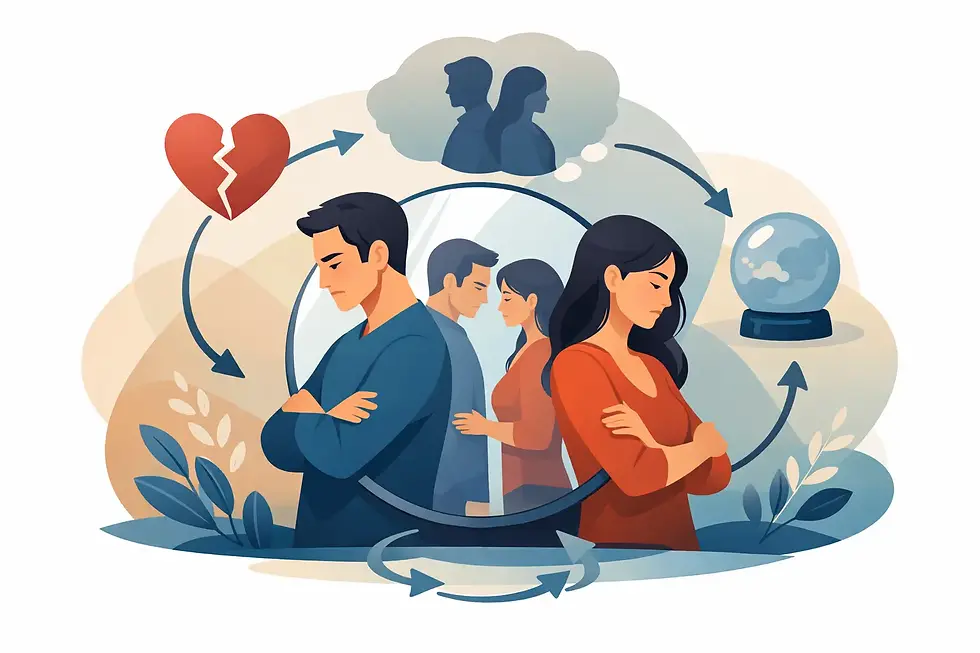
The problem is often not just the sensations themselves, but how they're interpreted. The thought "something really bad is happening" increases the fear, the fear intensifies the physical sensations, and a self-feeding cycle forms. The cognitive approach describes exactly this mechanism: catastrophic interpretations of normal bodily sensations can intensify panic (Clark, 1986).
This doesn't mean the sensations are imaginary — they're real and very unpleasant. It means your body has switched on as though there's immediate danger, even when there isn't.
If you're experiencing severe chest pain, feeling faint, or new or unusual physical symptoms for the first time, you need immediate medical evaluation. Familiarity with panic attacks should never lead to ignoring symptoms that need to be checked.
Strategies for Coping with Panic Attacks in the Moment
The goal isn't to forcefully "beat" the attack. The harder you fight to make every symptom disappear, the more closely you may end up monitoring them. The more useful goal is to stay present, let the wave pass, and avoid actions that feed the panic.
Name the experience in simple words
Tell yourself: "I'm going through a wave of panic. It's intense, but it will pass." The phrase doesn't need to fully convince you in that moment — it works as a more balanced alternative to the thought that you're losing control or in immediate danger.
You can also add: "I don't need to solve anything right now. I just need to stay here for the next minute." Focusing on a small window of time makes the experience feel less overwhelming.
Slow your breathing, without over-controlling it
Many people try to take very deep breaths. For some this helps, but for others it increases dizziness or the sensation of not getting enough air. Try a gentler approach: let the inhale be natural and make the exhale a little slower.
For example, breathe in gently through the nose and breathe out slowly, as if softly fogging up a piece of glass. Repeat for a few cycles, without counting rigidly. If focusing on your breathing makes you more anxious, drop the technique and shift to noticing your surroundings instead.
Ground yourself in the present
Panic pulls you inward, toward your body and toward danger scenarios. Grounding gently redirects attention to your surroundings. Look around and silently describe three objects: their color, shape, or texture. Feel your feet pressing into the floor, or hold a cool glass of water.
This isn't a distraction meant to "cancel" the attack. It's a way of reminding your nervous system that you're in the present, and that there's more information available than just the frightening sensations it's registering in that moment.
Stay, when it's safe to stay
Leaving immediately often brings relief. But it can teach the brain that the place, the situation, or the physical sensations really were dangerous. If you're in a safe environment, try staying a little longer, until the tension starts to ease.
This doesn't mean pushing yourself through every circumstance. If you're driving, pull over safely. If you're somewhere with genuine danger, remove yourself. The difference lies in not automatically abandoning a safe situation just because fear showed up.
What Often Keeps the Panic Cycle Going
After an attack, it's common for fear of the next one to begin. Someone might avoid the gym because a racing heart reminds them of an attack; another might avoid elevators or not travel without a companion. At first, avoidance seems logical. Long-term, though, it shrinks your life and reinforces the belief that you can't cope.
Constant body-checking, seeking reassurance from others, or the need to always have an "escape route" can play a similar role. You don't need to cut all of this out abruptly. It's more effective to notice which of these you rely on and gradually reduce your dependence on them.
Gradual exposure to avoided situations, with proper preparation and pacing, is a core element of cognitive-behavioral interventions for panic. The goal isn't to prove you'll never feel anxious again, but that you can keep functioning while anxiety is present (Craske et al., 2014).
A Personal Plan for Difficult Moments
A written plan is especially useful, because at the peak of panic, thinking narrows. Keep a short note on your phone with three lines: what's happening, what you'll do for the next two minutes, and what behavior you want to avoid.
For example: "This is panic and my body is in alarm mode. I'll press my feet into the ground, take slow exhales, and look around me. I won't leave the meeting right away, unless there's a real reason to." The plan should be realistic and tailored to your own circumstances, not perfect.
It also helps to note down, after the attack, what came before it: lack of sleep, too much caffeine, pressure at work, a conflict in the relationship, or a stretch of constant demands. This isn't about blaming yourself — it's about spotting patterns and making small, meaningful changes.
When Psychotherapy Can Make a Difference
If the attacks keep recurring, if you're organizing your day around the fear of them happening, or if avoidance is affecting your work, relationships, and ability to get around, psychotherapy can offer more systematic support. Cognitive-behavioral therapy helps you recognize the interpretations that intensify the fear, practice new responses, and gradually approach what you've started avoiding.
For people with demanding jobs, panic attacks are often tied to a broader lifestyle: constant readiness, high expectations, difficulty with boundaries, and very little time to decompress. In these cases, a single in-the-moment technique isn't enough — it's worth exploring what's keeping the system in a state of permanent overdrive.
Research shows that psychological interventions combining understanding of panic, changing thought patterns, and gradual practice in feared situations can significantly reduce the frequency and impact of attacks (Barlow, 2002). Progress, however, isn't always linear. One difficult week doesn't undo what you've already learned.
Hold Onto This
A panic attack can be frightening, but it isn't proof that you're weak or that your life will shrink forever. Every time you notice the wave, choose a calmer response, and stay a little longer in a safe situation, you're building a skill of real value: the trust that you can stand by yourself, even when anxiety is shouting.
References
Barlow, D. H. (2002). Anxiety and its disorders: The nature and treatment of anxiety and panic (2nd ed.). Guilford Press.
Clark, D. M. (1986). A cognitive approach to panic. Behaviour Research and Therapy, 24(4), 461-470.
Craske, M. G., Treanor, M., Conway, C. C., Zbozinek, T., & Vervliet, B. (2014). Maximizing exposure therapy: An inhibitory learning approach. Behaviour Research and Therapy, 58, 10-23.