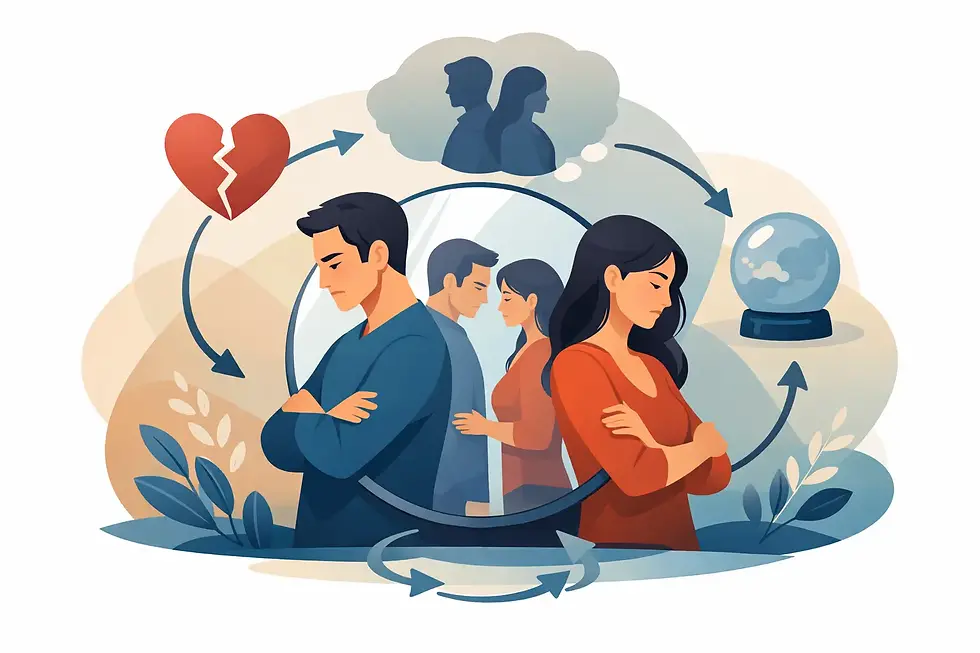
Self-Fulfilling Prophecy in Relationships: How to Break the Cycle
If someone takes a while to reply to a message, within a few minutes your mind has already reached a conclusion: “They’re pulling away.” This is a classic example of a self-fulfilling prophecy in relationships. It doesn’t start with what the other person does, but with what we interpret their behavior to mean—and how, without realizing it, we begin to act in ways that ultimately bring about exactly what we fear. In relationships, the self-fulfilling prophecy is not a theoretical concept. It is something seen daily in couples who love each other but find themselves trapped in repetitive cycles of misunderstanding, anxiety, and distance. Understanding this concept is particularly helpful when someone wants not just to “talk about the problem,” but to practically change the way they think, feel, and react.
What Is a Self-Fulfilling Prophecy in Relationships?
A self-fulfilling prophecy means that an initial belief or expectation influences our behavior in such a way that it increases the likelihood of that belief or expectation being confirmed. In relationships, this often happens when someone believes in advance that they will be rejected, betrayed, not good enough, or that their partner isn’t truly interested. This thought doesn’t just stay in the mind. It affects the tone of voice, the messages sent, body language, patience, jealousy, the willingness to talk, and even whether someone will seek affection or withdraw first “to avoid getting hurt.” This is the crucial point. The problem isn’t just negative thinking. It’s that thinking shapes behavior that changes the dynamics of the relationship.
A clear example of a self-fulfilling prophecy in relationships
Let’s look at a specific example of a self-fulfilling prophecy in relationships. Maria has a core belief: “People eventually get tired of me and leave.” When her partner, Nikos, is under more pressure at work and less available for a few days, Maria doesn’t see it as temporary stress. She interprets it as a sign of emotional distancing.
She starts sending messages more often to check in. If she doesn’t get an immediate reply, she becomes more blunt. She asks repeatedly, “Is something wrong?”, “Are you not yourself?”, “Is there something you want to tell me but aren’t saying?” When Nikos replies that he’s just tired, she isn’t reassured. On the contrary, she thinks he’s hiding something.
After a few days, Nikos does indeed start to feel overwhelmed by this constant tension. He feels like he has to apologize for every delay, every change in tone, every need for personal time. Gradually, he withdraws more and more—not because he wanted to leave from the start, but because the relationship has become emotionally suffocating.
Maria sees him pulling away and thinks, “I knew it. He’s finally drifting away.” In her mind, her fear has been confirmed. In reality, however, the very sequence of fear, control, and tension contributed to the outcome. This mechanism does not mean that the person who is afraid is “to blame.” It is usually a pattern rooted in past experiences, insecurities, or persistent cognitive schemas. But if it is not recognized, it continues to repeat itself.
How the cycle begins
Usually, the cycle begins with an automatic thought. It might be “they don’t love me as much as they used to,” “I’m definitely going to get hurt,” “if I’m not careful, they’ll leave me,” or “I don’t deserve lasting love.” These thoughts pop into your head quickly and often feel like reality, not just an interpretation.
Then the emotion kicks in: anxiety, fear, anger, shame, or jealousy. The body goes on high alert, and behavior follows. A person may become controlling, overly demanding, passively aggressive, cold, or excessively apologetic. In other cases, they avoid the conversation and withdraw first to avoid experiencing potential rejection.
The partner reacts to this behavior, not to the initial anxiety that caused it. This creates a vicious cycle in which one person’s reaction fuels the other’s fear.
Why do we see this so often in romantic relationships?
Romantic relationships touch on very basic needs: acceptance, connection, security, and self-worth. That is why they trigger deeper patterns than other areas of life. Someone who functions calmly and effectively at work may experience intense fear of abandonment or rejection in their relationship.
Furthermore, there is uncertainty in close relationships. We cannot know with absolute certainty what the other person is feeling or thinking at any given moment. When someone experiences heightened anxiety or has difficulty tolerating uncertainty, they tend to fill in the gaps with negative scenarios.
However, it doesn't always manifest in the same way. In one person, it appears as clinginess and a constant search for validation. In another, as coldness, distance, and control. The common thread is the same: an inner conviction that anticipates a negative outcome and, unwittingly, facilitates it.
How it differs from reasonable concern
Not every fear is a self-fulfilling prophecy. There are relationships where there is, in fact, inconsistency, secrecy, manipulation, or persistent emotional distance. In those cases, the concern is not a “misunderstanding,” but a sign that something is not working right.
The difference lies mainly in two points. First, whether the interpretation is based primarily on facts or primarily on preexisting fear. Second, whether the reaction helps clarify the situation or makes it worse. For example, a calm and clear discussion can be constructive. Pressure, control, accusations, and interrogations usually make the situation more confusing.
What helps break the pattern
Change begins when a person learns to distinguish between the fact and the interpretation. The fact is “he didn’t respond for three hours.” The interpretation is “he doesn’t care.” These two are often confused, especially when there is a history of anxiety or previous traumatic experiences in relationships..
In Cognitive-Behavioral Therapy, we work specifically on this connection between thoughts, emotions, and behavior. It’s not enough for someone to simply say, “I’ll think more positively.” They need to pinpoint the pattern precisely, identify the core belief that fuels it, and try out new, more functional ways of responding.
This may mean that before sending five consecutive messages, they will pause and consider alternative explanations. It might mean that they’ll express a need without making an accusation, saying, “I feel insecure when we lose touch suddenly, and it would help me if we could talk about it,” instead of “You never care.” It may also mean that they’ll tolerate a little uncertainty without immediately resorting to controlling behaviors.
The Importance of Communication Without Trials
When many people are afraid, they don’t ask directly for what they need. Instead, they test the other person. They sulk to see if the other person will take an interest, they withdraw to see if the other person will reach out, and they provoke jealousy to seek reassurance. These actions may seem protective, but they often increase uncertainty.
Direct communication is more difficult because it exposes one’s vulnerability. However, it is much more effective. It gives the other person real information about what is happening and reduces the likelihood of misunderstandings. It does not guarantee that every relationship will work out, but it helps evaluate the relationship based on facts rather than assumptions and reactions.
When to Seek Professional Help
If you notice the same pattern repeating itself in more than one relationship, if insecurity quickly turns into tension, if you have trouble controlling your reactions, or if you feel that your relationships are emotionally draining, support from a psychologist can be essential.
CBT is particularly helpful when we seek not only understanding but also structured change. That is, to recognize automatic thoughts, challenge cognitive distortions, identify underlying patterns, and practice new behaviors in real life. For many people, this is the path to ceasing to live in a state of constant confirmation of their worst fears.
The tricky thing about a self-fulfilling prophecy is that it seems like proof that “I was right.” The healing step is to ask yourself whether what happened was merely a prediction or also the result of a cycle that can be changed. That’s where true freedom in relationships begins.
In conclusion
Understanding the concept of self-fulfilling prophecy in relationships can be the first step toward change. If we recognize the patterns we create, we can change our behavior. This will allow us to build healthier relationships. I’m here to support you through this process. If you need help, don’t hesitate to seek professional support.