On Happiness: The Midlife Crisis Today
Updated: Aug 13
At 2:15 in the morning, when the house has quieted down and the notifications have stopped, many people around age 50 ask themselves the same question: "Is this the life I wanted?" The phrase "on happiness: the midlife crisis" describes exactly this moment of reassessment, without implying that something is "wrong" with you. This article aims to explain why midlife can bring worry, sadness, or irritability, how it affects relationships and work, and what practical steps can create more room for a meaningful life. The change doesn't need to be dramatic to be meaningful.
On happiness: the midlife crisis isn't always a crisis
The term "midlife crisis" is often used as a label for impulsive decisions, sudden changes, or a sense that time is running out. But the reality is more nuanced. Not everyone goes through an intense crisis at 50, and there's no specific year in which it's bound to appear.
For many, it's more of a period of taking stock. Parents grow older or need care, children become independent, a career path has stabilized or has lost its spark. The body sends different signals, and some of the certainties of youth start to fade. Developmental psychology describes midlife as a period of increased responsibilities but also a chance for reorientation, not as an inevitable collapse (Lachman, 2015).
The difficulty often doesn't come from the changes themselves. It comes from the gap between the life you're living and the life you believed you were supposed to be living. That "supposed to" can involve money, career progress, marriage, parenting, social recognition, or free time.
Why happiness seems to slip away in midlife
Large international studies have often found a U-shaped wellbeing curve: subjective satisfaction can dip in midlife and improve later on. This finding doesn't predict your own experience, but it explains why a sense of fatigue or doubt at this stage isn't unusual (Blanchflower, 2021).
By 50, you typically have more data to evaluate your choices. This is useful, but it can become painful when evaluation turns into relentless self-criticism. An executive might think they succeeded professionally but lost touch with their family. Someone else might feel they prioritized others and left their own desires behind. This isn't necessarily ingratitude. It's often the need to reconnect with what genuinely matters to you.
Happiness, after all, isn't a permanent state of euphoria. It includes satisfaction, connection, a sense of purpose, and the ability to tolerate uncomfortable emotions without letting them dictate all your decisions.
When pressure becomes a personal story of failure
Work-related pressure can bring particular intensity to this period. Competition, changing roles, demands from management, uncertainty, or exhaustion can reinforce the thought "I don't have the stamina I used to." In Athens, as well as for Greeks working abroad, this pressure is often compounded by distance from a support network, or by the expectation that you have to handle everything on your own.
A distinction is needed here: fatigue isn't proof of personal inadequacy. It can be a signal that the way your life is organized has stopped being sustainable. The answer isn't always to quit your job or change everything. Sometimes it's negotiating boundaries, revisiting priorities, or no longer measuring your worth solely by performance.
The midlife crisis within relationships
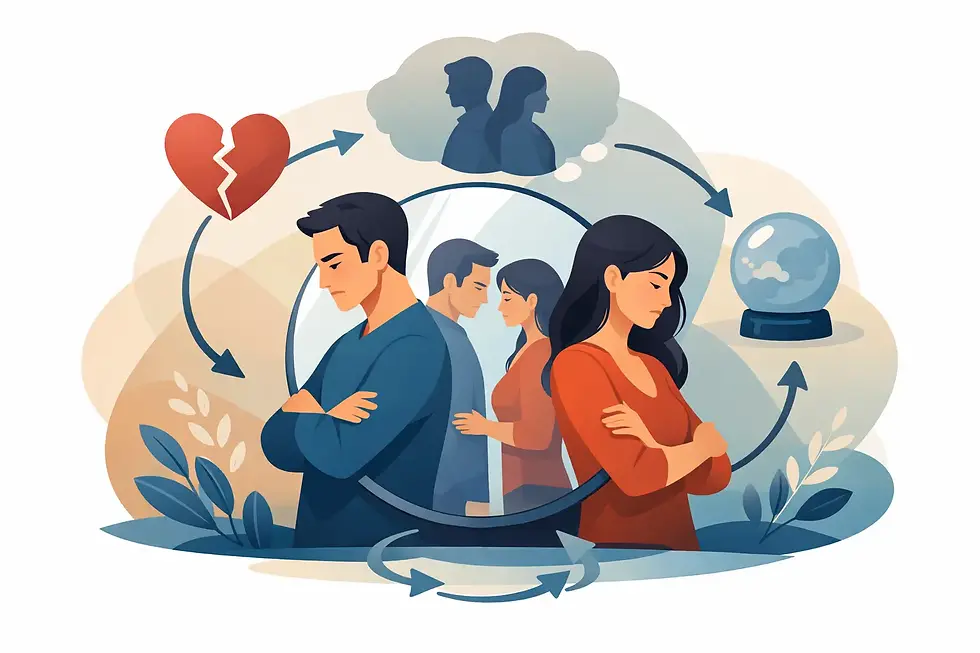
Midlife often brings to the surface issues a couple had learned to sidestep. When daily obligations shift, the relationship no longer has the same "schedule" that kept both people occupied. This is when distance, frequent arguments, sexual withdrawal, or a sense of living together without truly meeting can appear.
This doesn't mean the relationship is over. It means it likely needs a new way of communicating. Instead of "you never understand me," it helps more to say "I feel lonely when we only talk about obligations, and I'd like us to find time for us." This phrasing doesn't let the other person off the hook, but it lowers defensiveness and opens space for conversation.
Emotional regulation often becomes more effective with age, as people invest in relationships that have substance instead of scattering their energy across every social demand. This is also described by socioemotional selectivity theory (Carstensen, 2006). Still, this choice needs to be made consciously, not through isolation or silence.
How to navigate this period without rushed decisions
The need for change is real, but haste isn't always your ally. When someone feels trapped, an abrupt decision can look like relief. It may well be the right move, but it's worth exploring first: what exactly do you want to leave behind, and where do you want to move toward?
Start by tracking, for two weeks, which moments drain you and which give you even a small sense of aliveness. Don't limit this to big experiences.
A quiet morning, an unhurried conversation, physical movement, or a task that ends cleanly can point to what's missing.
Next, notice your automatic thoughts. Phrases like "I'm too late," "I should have achieved more," or "if I change, I'll ruin everything" feel like facts when we repeat them often. But they're interpretations. A cognitive-behavioral approach helps examine how accurate and how useful these thoughts really are, so they don't end up making decisions for you (Beck, 2020).
Also make room for small experiments. If you're missing creativity, you don't need to overhaul your career in a week. You can start a course, take on a different project, or protect two hours a week for an activity that has personal meaning. Small, repeated changes offer clearer information than an impulsive escape.
When support can make a difference
If worry, sadness, irritability, or isolation persist and affect your work, sleep, relationship, or daily functioning, talking with a psychotherapist can offer a safe framework. You don't need to have all the answers before you start. It's enough to sense that your old way of coping no longer serves you.
Individual psychotherapy can help you separate a genuine desire from the pressure of comparison. Couples therapy can be useful when one person's change has started to create distance or conflict in the relationship. For people with heavier professional responsibilities, working on boundaries, assertive communication, and stress management can turn a period of exhaustion into a period of more mature choice.
Turning 50 doesn't ask you to prove you're still young. It invites you to decide, with more honesty and less guilt, what's worth keeping and what's worth changing. And that decision can begin with a simple, quiet question: "What would make my next week a little more my own?"
References
Beck, J. S. (2020). Cognitive behavior therapy: Basics and beyond (3rd ed.). Guilford Press.
Blanchflower, D. G. (2021). Is happiness U-shaped everywhere? Age and subjective well-being in 145 countries. Journal of Population Economics, 34(2), 575-624.
Carstensen, L. L. (2006). The influence of a sense of time on human development. Science, 312(5782), 1913-1915.
Lachman, M. E. (2015). Mind the gap in the middle: A call to study midlife. Research in Human Development, 12(3-4), 327-334.