How Dysfunctional Schemas Work
There are moments when a small delay in a text reply, a comment at work, or an argument with a partner feels disproportionately heavy. You might rationally know it doesn't mean rejection or failure, but feel as though it confirms exactly that. Understanding how dysfunctional schemas work helps explain this apparent contradiction. In this article you'll see what schemas are, how they form, why they get triggered in relationships and at work, and how you can start recognizing them without blaming yourself. The goal isn't to put a label on your experience, but to gain more room for choice.
What Dysfunctional Schemas Are
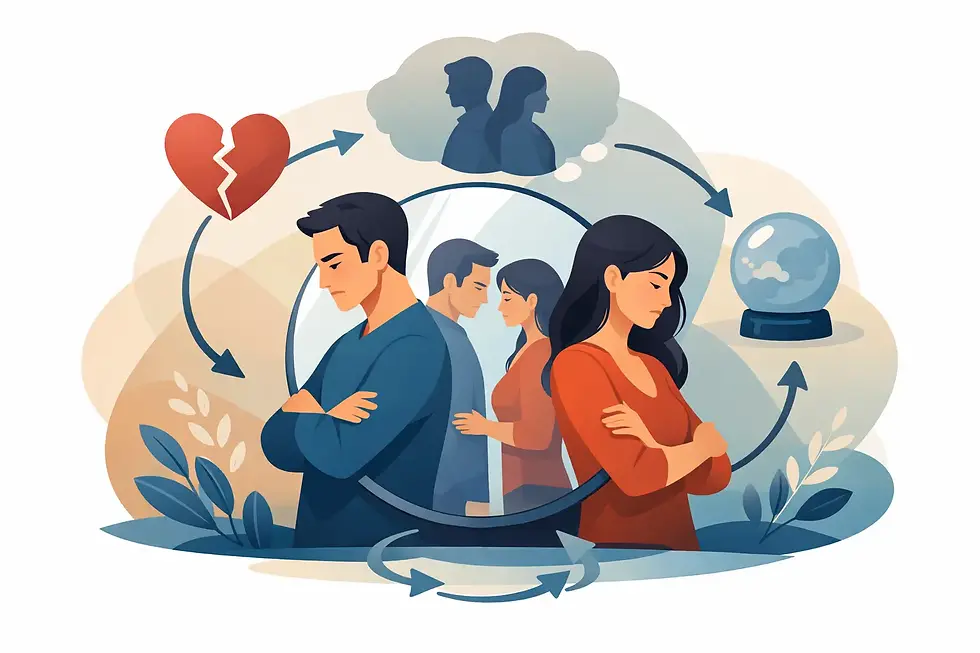
Dysfunctional schemas are deep, repeating patterns through which we interpret ourselves, others, and relationships. They usually include a core belief, an intense emotion, and a familiar way of reacting. For example, the abandonment schema might be linked to the thought that important people will leave, to anxiety or anger, and to behaviors like excessively seeking reassurance or, conversely, pulling away.
This isn't simply a negative thought of the moment. The thought "I made a mistake in that presentation" is specific and can be examined. A schema is more general and persistent, like "if I don't do everything perfectly, I'll lose my worth." That's why it often affects many areas: romantic relationships, friendship, parenting, self-confidence, and work.
Schema therapy theory describes schemas as patterns that often begin early in life and continue to affect adult functioning, especially when a current experience feels emotionally similar to earlier difficulties (Young et al., 2003).
How Dysfunctional Schemas Work in Practice
A schema isn't permanently active. It can stay in the background until a trigger touches it. That trigger doesn't need to be objectively serious. It could be the tone of someone's voice, the sense of not being included in a decision, or uncertainty about where a relationship stands.
Take the example of an executive who gets brief feedback from their boss: "This needs some improvement." If a failure schema is active, the comment might be instantly translated as "I'm not competent enough, I'll be exposed." Anxiety rises, attention narrows, and this may be followed by overworking, procrastination, or defensiveness. The problem isn't that the person doesn't want to improve — it's that the brain treats a limited piece of feedback as proof of overall personal inadequacy.
In relationships, a similar pattern can appear when the other person asks for some time to themselves. For someone with an emotional deprivation or abandonment schema, this can be experienced as coldness or a sign of an impending breakup. The reaction might be intense protest, controlling behavior, silence, or withdrawal. In this way, the original need for security can inadvertently increase the very distance it fears.
The Three Common Coping Styles
When a schema is activated, we usually don't react randomly. We tend to surrender to it, avoid it, or overcompensate for it.
Surrender means acting as though the schema's belief were fact. Someone who feels unworthy might accept relationships or working conditions that exhaust them, because they believe they don't deserve to ask for more.
Avoidance can offer temporary relief. You might not express needs, avoid commitment, put off a difficult conversation, or keep distance from people you care about. The cost is that the schema is never actually tested against reality.
Overcompensation looks more dynamic, but often hides the same vulnerability. Someone afraid of being controlled might try to control everything. Someone who feels inadequate might allow no mistakes, either in themselves or in others. These strategies usually had some usefulness in the past. In adult life, though, they can limit closeness, flexibility, and calm.
Why They Repeat, Even Though They Hurt Us
A difficult but relieving point is that schemas don't repeat because you enjoy suffering or because you're not trying hard enough. They repeat because they're familiar. The mind often prefers a familiar interpretation, even a painful one, over an unfamiliar and more balanced one.
Furthermore, when a strong emotion is present, we tend to seek out evidence that confirms the schema and overlook what contradicts it. If you believe others reject you, a neutral response might look like rejection, while a clear sign of interest gets treated as the exception. This isn't a conscious choice — it's a fast, learned way of processing experience.
Research on schema therapy shows that working with these persistent patterns can be especially useful when the difficulties are chronic and consistently affect relationships and self-image (Arntz & Jacob, 2013).
How to Start Recognizing Them
Change usually doesn't begin by telling yourself to "think positive." It begins with more precise observation. Next time a reaction feels overly intense, try pausing on four questions:
What exactly happened, without interpretation?
What did I immediately tell myself it meant?
What emotion showed up, and how intense was it?
What did I do to protect myself?
For example, if a colleague doesn't reply right away, the fact is the delay. The interpretation might be "they're ignoring me." The emotion might be anxiety or anger, and the protective reaction might be a pushy follow-up message or complete silence. Walking through this sequence helps you see the schema in motion, before it becomes an automatic driver of your behavior.
A More Balanced Response Isn't a Denial of Feeling
Recognizing the schema doesn't mean invalidating what you feel. You can say: "Part of me is afraid I don't matter to them. That feeling is real. But it doesn't mean my interpretation is the only possible one." From there, look for more information and choose one small, more functional action.
At work, this might mean asking for clear feedback instead of assuming disaster. In a relationship, it might mean expressing your need without blame: "When I don't hear from you, I get anxious. It would help to know when we'll be able to talk." There's no single correct response for everyone — it depends on context, the relationship, and whether the environment is genuinely safe and reciprocal.
The Role of Psychotherapy in Changing Schemas
Individual psychotherapy offers a stable space to identify these patterns precisely and connect them to present-day difficulties, without reducing your experience to a simple "it's the past's fault." The work involves both understanding and practicing new ways of communicating, setting boundaries, and caring for yourself.
In couples therapy, schemas can help illuminate the cycle behind recurring conflicts. It isn't about finding who's to blame. Often, two people trigger each other's vulnerabilities: one pushes for closeness, the other withdraws to protect themselves, and the cycle intensifies. Recognizing this pattern creates a more practical foundation for change.
Clinical evidence supports schema therapy as contributing to meaningful, lasting improvement for people with long-standing, complex patterns of difficulty (Bamelis et al., 2014). Progress, however, isn't linear. There will be moments when an old schema gets triggered again. The difference is that, gradually, it won't need to dictate your every next move.
Dysfunctional schemas may explain why certain situations hurt you so much, but they don't define who you are. Every time you notice the pattern, name the need hiding beneath it, and choose a slightly different response, you build a more trustworthy relationship with yourself.
References
Arntz, A., & Jacob, G. (2013). Schema therapy in practice: An introductory guide to the schema mode approach. Wiley-Blackwell.
Bamelis, L. L. M., Evers, S. M. A. A., Spinhoven, P., & Arntz, A. (2014). Results of a multicenter randomized controlled trial of the clinical effectiveness of schema therapy for personality disorders. American Journal of Psychiatry, 171(3), 305-322.
Young, J. E., Klosko, J. S., & Weishaar, M. E. (2003). Schema therapy: A practitioner's guide. Guilford Press.