How do I control panic attacks practically?
Updated: Aug 13
If you have suddenly found yourself with a racing heart, shortness of breath, dizziness, or an intense fear that “something really bad is happening,” it is entirely reasonable to wonder how I control panic attacks when they seem to overwhelm me. The purpose of this article is to give you a clear, practical, and scientifically proven picture of what is happening in your body and mind at that moment, as well as what you can do immediately and consistently to reduce the intensity and frequency of these episodes. You will see what helps during the crisis, what mistakes maintain it, and when more organized psychotherapeutic support is needed (Barlow, 2002; Clark, 1986).
What is a panic attack in practice?
A panic attack is a sudden surge of intense fear or discomfort accompanied by physical and mental symptoms. Often, there is a rapid heartbeat, a feeling of choking, trembling, sweating, dizziness, numbness, or a fear of losing control. The most difficult part is that the experience feels threatening, even when there is no real danger.
This does not mean that “it’s all in your head” in the pejorative sense that is often used. It means that the body activates the alarm system much more quickly and intensely than necessary. The body reacts as if there is danger, and the mind tries to explain this tension, often with catastrophic interpretations such as “something bad is happening to me” or “I’m going to collapse” (Clark, 1986).
How do I control panic attacks when they happen?
The first step is to remember something that sounds simple but is essential: a panic attack peaks and then subsides. It doesn't last forever, no matter how endless it may seem at the time.
What helps most is to reduce the struggle with the symptom. When you desperately try to stop your heart rate, control your every breath, or make sure nothing happens, your body's surveillance often increases, and with it your anxiety. Instead, try to name what's happening with calm precision: "This is a panic attack. It's very unpleasant, but it will pass."
Breathing can help, but not as a frantic attempt to immediately "fix" your body. Slow, steady breathing, with a slightly longer exhale than inhale, is more helpful. For example, inhale for 4 counts and exhale for 6. The goal is not to have perfect technique. The goal is to send a message to the nervous system to slow down.
Grounding in the present is equally helpful. Look around you and mentally describe five things you see, four things you touch, and three things you hear. This shift of attention does not eliminate the judgment, but it does reduce the vicious cycle between fear and physical arousal. Grounding techniques have been shown to be helpful in managing intense anxiety, especially when combined with psychotherapy training (Craske & Barlow, 2007).
What not to do when trying to control a crisis
Many people start avoiding places, routes, or situations that they have been afraid of in the past. Others constantly carry “safety nets”: I don’t go out alone, I always want someone on the phone, I only sit near the exit, I don’t get on public transportation, I don’t go in lines or closed spaces. These strategies provide temporary relief, but often perpetuate the problem in the long run.
The same thing happens when you constantly monitor your body. If every change in heart rate, dizziness, or breathing is interpreted as a sign of an impending seizure, the brain is trained to remain on alert. Thus, your attention becomes hypersensitive to the body's normal ups and downs.
There is an important detail here: it does not mean that you should force yourself violently. The goal is not to “harden up.” It is to gradually stop giving symptoms the meaning of danger.
Why panic attacks come back
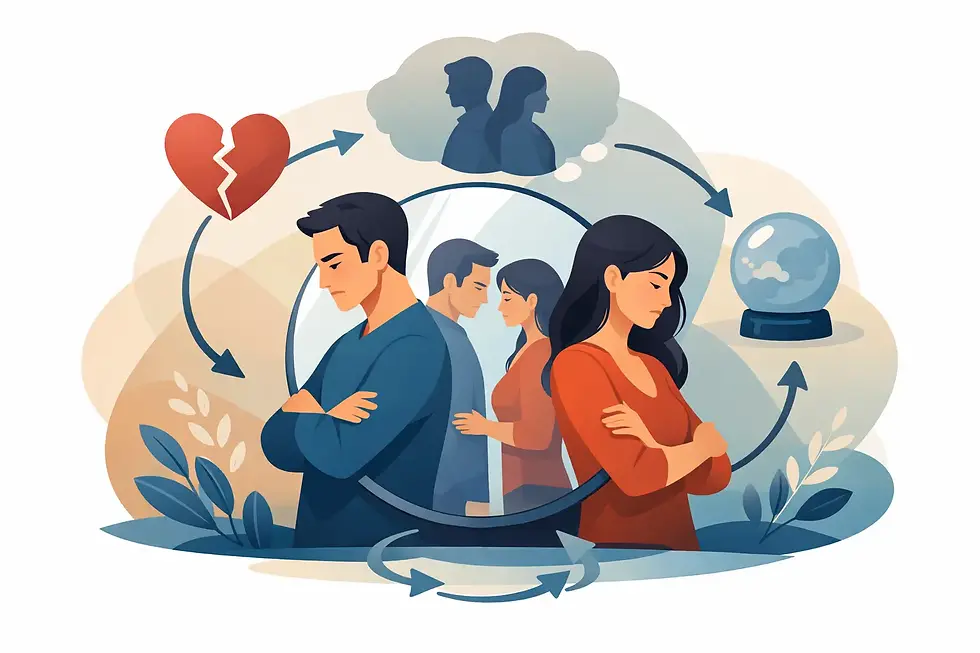
They usually don't come back because you're a weak character or because you're "not handling it well." They come back because a vicious cycle is created. You feel a physical symptom, you interpret it as a threat, you get more scared, the body activates even more intensely and this confirms your fear.
This model has been described extensively in the cognitive theory of panic. Catastrophic interpretations of bodily sensations are a central mechanism in the maintenance of panic attacks (Clark, 1986). Simply put, it is not just the symptom that is frightening. It is the meaning that the mind gives to it at that moment.
For some people, crises occur during times of great stress, change, loss, or accumulated exhaustion. For others, they are more related to a more general fear of losing control or heightened sensitivity to bodily sensations. There is no one-size-fits-all explanation. That’s where a personalized understanding of your pattern can help.
How do I control panic attacks long-term?
Real change comes when you start to change your relationship with your symptoms, not just when your symptoms subside. This means learning to recognize the first signs of anxiety without immediately going into a panic.
It's helpful to keep a simple diary for a while. Not to obsessively monitor yourself, but to see patterns. When does the crisis occur? What preceded it? What thought went through your mind? What did you do to feel safe? This often reveals that crises are not as "random" as they seem.
On a second level, it requires gradual exposure to what you have begun to avoid. If you have associated, for example, the subway, driving, the supermarket, or being alone with danger, slow and organized re-exposure helps the brain relearn that discomfort is not the same as threat. The cognitive-behavioral approach has strong evidence for managing panic precisely because it works on this mechanism (Craske & Barlow, 2007).
At the same time, it helps to take care of the basic rhythms of everyday life. Insufficient sleep, constant overexertion, excessive caffeine and lack of recovery do not “cause” panic attacks by themselves, but they often increase the overall vulnerability of the body. They are not the only cause, but they are factors worth taking seriously.
When does psychotherapy actually help?
If your panic attacks are starting to limit your daily life, affecting your work, transportation, sleep, or relationships, psychotherapy can be much more effective than trying to manage them on your own. The point is not just to get general advice, but to understand your own panic cycle and work on the thoughts, avoidances, and safety reactions that maintain it.
In a safe therapeutic setting, you can learn to recognize your internal signals, reduce the destructive interpretation of symptoms, and gradually return to activities you have abandoned. For many people, this is also the point where their sense of self-confidence changes significantly. They no longer wait for it to “never happen again.” They learn that even if it does occur, they can endure it and manage it.
This is especially important for people who live a busy daily life in Athens or for Greeks abroad who feel like they are carrying stress without a stable support system around them. When life constantly demands functionality, the feeling that “I can’t trust my body” becomes very burdensome. Fortunately, this feeling can change. A meta-analysis of randomized controlled trials confirms that CBT is an effective treatment for adult anxiety disorders, including panic disorder (Hofmann & Smits, 2008).
Some phrases that help in times of crisis
Sometimes, the right phrase at the right time acts as an anchor. You can try mentally: “My body is on alert, not in real danger,” “It doesn’t need to disappear now for me to make it,” “I’m letting the wave pass.” This is not positive thinking in the superficial sense. It’s a realistic repositioning of the experience.
If a phrase sounds foreign or overly optimistic, don't force it. Choose words that resonate with you. Authenticity helps more than any technique when trying to build inner stability.
Panic attacks can make you feel vulnerable, but they don't define you. Each time you stay present, you understand their mechanism a little better and react with less fear, you build ground under your feet.
Bibliography
Barlow, DH (2002). Anxiety and its disorders: The nature and treatment of anxiety and panic (2nd ed.). Guilford Press.
Clark, DM (1986). A cognitive approach to panic. Behavior Research and Therapy, 24(4), 461-470.
Craske, MG, & Barlow, DH (2007). Mastery of your anxiety and panic: Workbook (4th ed.). Oxford University Press.
Hofmann, SG, & Smits, JAJ (2008). Cognitive-behavioral therapy for adult anxiety disorders: A meta-analysis of randomized placebo-controlled trials. Journal of Clinical Psychiatry, 69(4), 621-632.