Are you stopping feeling joy? 7 signs of numbing
If you've been thinking "are you stopping feeling happy? 7 signs you're numbing yourself" lately and wondering if this describes your own experience, you're not alone. Many people don't exactly feel sad or broken. Instead, they feel "numbed," as if they've been cut off from joy, excitement, and even their own lives. In this article, we'll look at what numbing yourself is, how it differs from simple fatigue or low mood, what the 7 most common signs are, and when it's worth seeking more systematic support. The goal is not to label yourself, but to better understand what's happening to you.
What is emotional numbness?
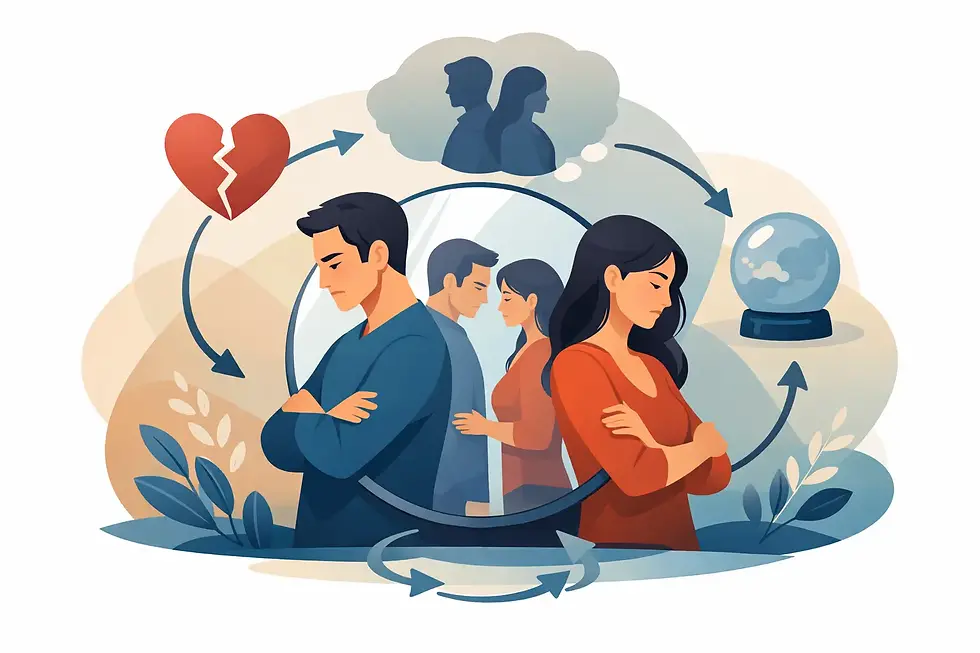
Emotional numbing is a condition in which a person feels reduced access to their emotions. This doesn't just apply to difficult emotions, such as sadness or fear. It often also reduces the ability to experience joy, interest, tenderness, or excitement. Sometimes it feels like an inner silence. Other times it feels like you're functioning normally, but without a real connection to what you're experiencing.
This experience can occur after prolonged stress, loss, emotional exhaustion, or repeated pressures in relationships and work. It can also be associated with anxiety and depressive difficulties , but not all numbness is the same for everyone. Literature shows that emotional detachment often functions as a way of psychological protection when the nervous system has been overloaded for a long time (American Psychiatric Association, 2022).
Are you stopping feeling joy? 7 signs that you have emotional numbness
1. Things that used to please you no longer mean much to you.
Maybe you're hanging out with friends, listening to music, watching your favorite show, or going for a walk, and the experience feels flat. It's not necessarily that you're having a bad time. You just feel almost nothing. This "neither good nor bad" feeling is a common sign of numbing.
2. You have difficulty getting emotional or crying.
People who used to have easy access to their emotions often describe being unable to cry, even when something happens that would logically touch them. Others say they know they “should feel something,” but they don’t. This doesn’t mean indifference. It often means blocking.
3. You feel disconnected from others
Emotional numbing often affects relationships as well. You may be with your partner, family, or friends and it feels like there’s an invisible glass wall between you. You’re present, but not truly close. Research shows that reduced emotional responsiveness can take a toll on your sense of intimacy and connection (Gross, 2015).
4. You function mechanically during the day
You get up, you work, you answer messages, you fulfill obligations, but everything happens on automatic. Not only is the joy missing. The feeling of participation is also missing. It's like watching yourself do what you have to do, without any inner presence.
5. You have less empathy or patience.
Some people notice that they are not easily touched by others either. They feel more "closed off", more distant, perhaps even more irritable. This can create guilt, especially when it concerns loved ones. But emotional exhaustion often temporarily reduces mental availability, it does not make you a bad person.
6. You seek intense stimulation to feel something
Sometimes numbness doesn't look like immobility. It looks like a constant need for screens, overwork, endless scrolling, eating, or other time-filling behaviors that momentarily increase tension. Not always for pleasure, but to break the internal flatness.
7. You find it difficult to describe what you feel.
When someone asks you “how are you?” you may answer “fine,” “tired,” or “I don’t know.” Difficulty in identifying and describing emotions is common after prolonged stress. It is not necessarily a lack of self-awareness. It may be an indication that emotional contact has been temporarily limited (Sifneos, 1973).
Why does numbing happen?
It usually doesn't come out of nowhere. It can follow a period of chronic stress , a persistent conflict in a relationship , a bereavement, a move, the pressure of work, or the loneliness that many people experience even in the midst of a busy schedule. For Greeks living abroad, this experience is sometimes also linked to the constant effort to adapt, the distance from their supportive environment, and the feeling of having to cope without much support.
There's something else. Our psyche sometimes "turns down the volume" to protect us from overload. The problem is that when access to pain is closed, access to pleasure is often also reduced. This is why numbing can seem confusing. It protects you and at the same time distances you from yourself.
When is it not just tiredness?
Simple fatigue usually improves with rest, better sleep, and some distance from stress. Emotional numbness tends to be more persistent and affect more areas of life. If you're not getting touched by things that matter to you, if your relationships start to empty, or if you feel "off-line" for weeks, then it's worth taking a closer look.
You don't have to wait for it to get worse. Many people only seek help when they feel they can't take it anymore. In practice, however, understanding what's happening early on makes all the difference.
What can you do in practice?
The first step is to not force yourself to “feel normal.” Self-blame often deepens the disconnect. It’s more helpful to notice when you feel more numb and when you feel a little less. For example, some people feel more disconnected after a stressful time at work, others after a conflict, and others after spending hours passively consuming screens.
It also helps to return to small, specific experiences of the body and everyday life. Not as a magic solution, but as a way to reconnect. A short walk without a cell phone, a stable sleep schedule, a few minutes of real pause during the day and recording two or three words about what you felt can open a first channel of contact. Emotional awareness is cultivated gradually, it does not appear on command (Linehan, 2015).
If numbness persists, psychotherapy can be of great help. Not just to “talk” about it, but to identify what’s fueling it, how it manifests in your body and relationships, and what’s needed to safely regain greater emotional vitality. In some cases, a more careful psychological assessment can help clarify whether it’s a temporary reaction to stress or a more established pattern that needs a different approach.
When is it worth talking to a specialist?
If you feel like joy has been missing for a long time, if your relationships have become flat, or if you are struggling to understand what is happening to you, you don't have to interpret it yourself. Professional support is not an exaggeration. It is a practical way to give meaning to an experience that now seems blurry.
In psychotherapy, the goal is not to convince you to feel something specific. It is to create enough safety so that you can return, at your own pace, to the things you have learned to shut down or endure in silence. This is especially important when you are used to appearing functional on the outside, while inside you feel empty.
Joy doesn't always come back with a bang. It often comes back quietly, through small moments of connection with yourself, a little more presence in your day, and the feeling that you no longer have to numb yourself to get by.
References
American Psychiatric Association. (2022). Diagnostic and statistical manual of mental disorders (5th ed., text rev.).
Gross, JJ (2015). Emotion regulation: Current status and future prospects. Psychological Inquiry, 26(1), 1-26.
Linehan, MM (2015). DBT skills training manual (2nd ed.). Guilford Press.
Sifneos, PE (1973). The prevalence of alexithymic characteristics in psychosomatic patients. Psychotherapy and Psychosomatics, 22(2), 255-262.