Why Do I Experience Physical Symptoms of Anxiety, and What Can I Do About It?
Updated: Sep 10
A tight chest before a difficult meeting, a knot in your stomach for no apparent reason, or a headache at the end of a stressful week are not “your idea.” If you’re wondering “why do I somatize stress?”, this article aims to explain in a simple way how thoughts, feelings, and physical reactions are connected. You’ll see which symptoms occur most often, why they persist, when it’s worth getting a medical checkup, and how a cognitive-behavioral approach can help you gradually change your relationship with them. The goal is not to ignore your body, but to listen to it more accurately and with less fear.
Why do I embody anxiety?
Anxiety is not just a thought or a feeling. It is also a normal response to alertness. When the brain perceives a threat—for example, a deadline, a conflict, financial uncertainty, or the fear of failure—it activates the body's alarm system. Breathing may become faster, muscles tighten, the heart beat faster, and digestion may change.
These changes make sense when immediate action is needed. The problem occurs when the alarm often remains active, even when the threat is not present or does not require such intensity. Then the body may express pressure that has not been recognized, not spoken, or has not found another way to release. The connection between stress and physical symptoms is well documented, especially when the worry becomes persistent and attention is constantly focused on the sensations of the body (McEwen, 2007).
Somatization does not mean that you are "faking" or that the symptoms are not real. Pain, palpitations, nausea, or exhaustion are real experiences. What may be psychological is one of the factors that triggers, intensifies, or maintains them.
How the cycle of anxiety and symptoms is created
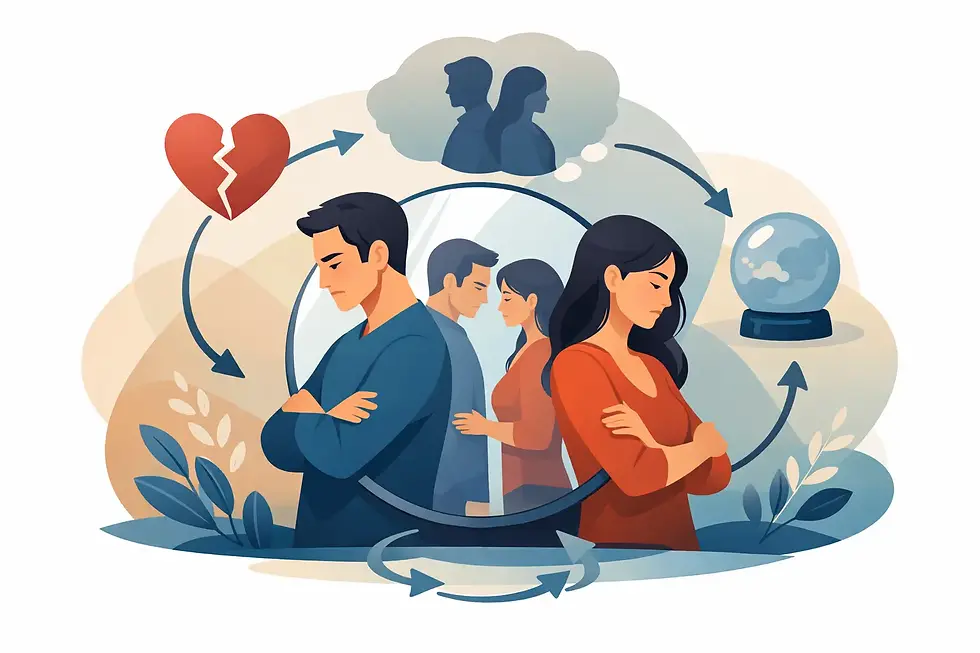
Often it is not the initial physical symptom that is most difficult, but its interpretation. You may feel dizzy and think, “Something serious is happening.” The thought increases the fear, the fear activates the body more, and the dizziness becomes more intense. Thus, a vicious cycle is created.
Cognitive behavioral therapy looks at exactly this interaction: state, thought, feeling, physical sensation, and behavior. For example, avoiding the subway because you once felt short of breath may provide temporary relief. In the long run, however, it teaches the brain that the subway is dangerous and increases vigilance the next time.
Constantly seeking reassurance, repeatedly checking your pulse, or monitoring every small change in your body can also perpetuate anxiety. This is not a lack of logic. These are understandable attempts to feel safe, but they sometimes have the opposite effect (Craske et al., 2009).
What symptoms may be related to stress?
Anxiety does not manifest itself in the same way for everyone. Some people experience mainly digestive symptoms, while others experience muscle tension or a feeling of exhaustion. Common symptoms include headaches, neck and shoulder tightness, stomach or intestinal discomfort, shortness of breath, palpitations, sweating, trembling, and difficulty sleeping.
There are also more subtle expressions: jaw tightness, skin irritations that worsen during times of stress, frequent fatigue, or a vague feeling of “I can’t relax.” The pattern is more important than a single symptom. If the irritation increases before demanding tasks, after conflicts, or during times of overload, this observation can provide useful information.
However, it is not true that every physical symptom is due to stress. Hastily attributing all discomforts to stress can leave you without proper care. Balance is needed: neither catastrophizing nor belittling.
When is a medical checkup needed?
A proper medical check-up is useful when a symptom is new, severe, persistent, changes in character, or significantly affects your functioning. It is also the right choice when there are symptoms such as sudden or severe chest pain, fainting, severe difficulty breathing, or neurological changes.
If organic factors have been ruled out and anxiety is still prevalent, the focus can shift from “how do I immediately eliminate every sensation?” to “how do I reduce the cycle of fear and avoidance?” Safety does not require absolute certainty about every bodily sensation. It requires reliable assessment and a realistic management plan.
What can you do when your body is on alert?
The first helpful move is to name the experience without invalidating it: “I notice a tightness in my chest and I’m feeling anxious right now.” This phrase is not a positive thought or a promise that everything will go away. It’s a way to stop automatically identifying the symptom with a danger.
Then, slow your breathing slightly, without trying to take too many deep breaths. A calm exhalation that is slightly longer than your inhalation for a minute or two can help your body get the message that it doesn’t need to escalate its response. If focusing on your breath makes you more anxious, try turning your attention to your surroundings: mentally describe five things you see or feel your feet on the floor.
It also helps to record the context of your symptoms for a few days: what preceded them, what thought came up, how intense the symptom was, and what you did afterward. Not to scrutinize your body, but to identify patterns. You may find that the intensity increases not by chance, but when you keep saying “yes,” when you put off a difficult conversation , or when you function for weeks without adequate rest.
Exercise, more consistent sleep, regular meals, and cutting back on excessive caffeine aren't magic bullets. But they do create a more stable foundation so that your nervous system doesn't start out already stressed. Similarly, completely avoiding any activity that was previously associated with stress will usually limit your life. Gradual, safe re-exposure to what you're avoiding is often more effective than waiting until you feel completely ready.
How CBT, ACT, and DBT help
CBT doesn't treat the body as the enemy. It aims to identify the thoughts that set off the alarm, evaluate them more realistically, and change behaviors that perpetuate the anxiety. This may include gradually reducing controls, managing avoidance, and practicing new ways of coping.
ACT adds an essential dimension: you don’t have to win the war with every unpleasant feeling to get on with your life. You can learn to make room for discomfort while choosing small actions that are connected to your values, such as connecting with people, taking care of your health, or being professional. Psychological flexibility is associated with better adaptation when stress cannot be eliminated immediately (Hayes et al., 2006).
DBT skills are especially helpful when tension is running high. Nonjudgmental observation, tolerance for discomfort, and effective communication can reduce the likelihood that stress will build up until it is expressed only through the body. The right approach depends on your pattern, your daily routine, and how limiting your symptoms are.
You don't have to prove you can "bear it" by ignoring what you're feeling. Your body is probably trying to let you know that your pace, demands, or the way you handle stress needs attention. With support, observation, and small, consistent changes, you can learn to listen to this message without living under its control.
References
Craske, MG, Wolitzky-Taylor, KB, Labus, J., Wu, S., Frese, M., & Lang, AJ (2009). Anxiety disorders. In JC Trivedi & JE Daly (Eds.), The science of mental health . Oxford University Press.
Hayes, SC, Luoma, JB, Bond, FW, Masuda, A., & Lillis, J. (2006). Acceptance and commitment therapy: Model, processes and outcomes. Behavior Research and Therapy, 44 (1), 1-25.
McEwen, BS (2007). Physiology and neurobiology of stress and adaptation: Central role of the brain. Physiological Reviews, 87 (3), 873-904.