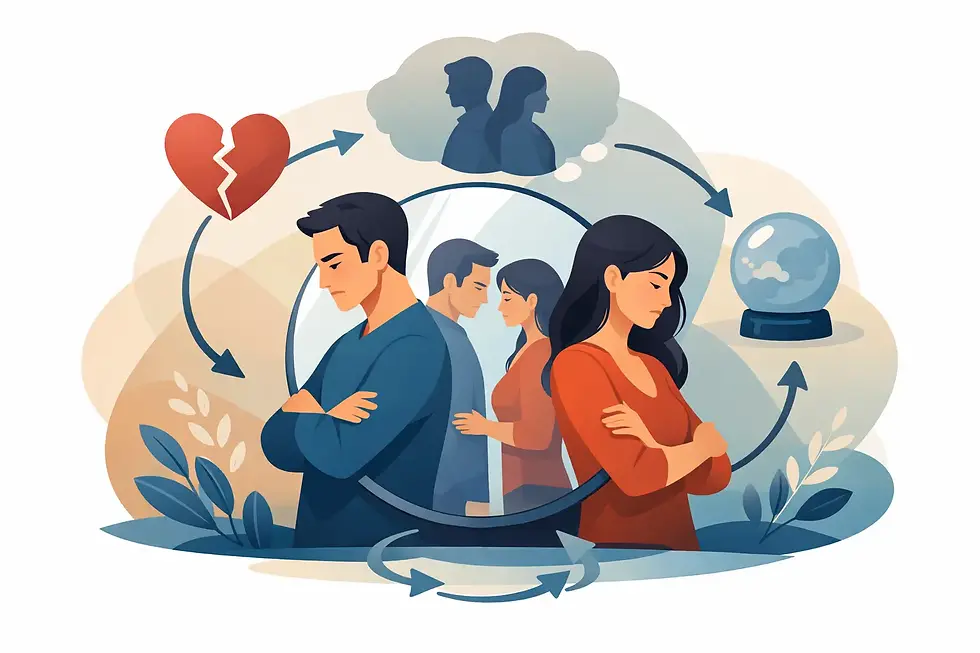
Why do you always attract the wrong people?
The phrase “I attract the wrong people” sounds like there’s an invisible magnetic field. In reality, we’re more often talking about patterns of choice and staying. It’s not just who approaches you. It’s who you’re intensely interested in, who you give time to, what behavior you explain away, what signs you ignore, and where you struggle to set boundaries.
The human mind does not always choose what is good for us. It often chooses what is familiar. If you have learned to associate love with uncertainty , distance, or effort, a calm and stable relationship may initially seem “little,” while an unstable relationship may seem intense, real, or fatal. It is not because you want to hurt. It is because your nervous system recognizes as familiar what it once learned to endure.
The pattern you need to break isn't always obvious.
Many people think the problem is “I’m picking the wrong characters.” Sometimes that’s true. More often, though, the underlying pattern is one of the following: you’re seeking validation from people who can’t give it, you’re confusing tension with connection, or you feel responsible for rescuing, understanding, and waiting for the other person to become available.
This pattern can take many forms. Maybe you are attracted to people who constantly need your space and you try not to “push.” Maybe you are won over by those who give you crumbs of interest and you experience them as a great reward. Maybe you feel attracted when you have to prove your worth. In all of these cases, you are not choosing just one person. You are repeating a familiar mental role.
When intimacy looks like love
One of the hardest parts is understanding that intimacy doesn't always equate to safety. Something can feel "home" to you and yet hurt you. If you grew up with inconsistency, rejection, over-criticism, or emotional ambiguity, you may be more attracted to people who replicate some of that experience.
Psychology knows this well: humans tend to repeat familiar relational situations, often unconsciously, as if trying to fix them this time. The difficult thing is that relationships are not healed by hope alone. If the other person is not truly available, your own persistence is not enough.
When you call the first signs "details"
At the beginning of a relationship, many warning signs go unnoticed not because of a lack of logic, but because of a need. If you're afraid of loneliness, if you're tired of disappointments, or if you really want it to work this time, you're more likely to explain away behaviors that would normally trouble you.
You say that he is just stressed, that he is having trouble expressing himself, that he has had a hard time, that you do not want to be strict. Understanding is a valuable quality. Without boundaries, however, it becomes a trap. Your ability to explain the other person does not protect you. Your ability to see what he is doing consistently protects you.
How is this pattern created?
There is no one answer for everyone. For some, the root lies in their early relationships and how they learned to ask for or not ask for care. For others, the pattern was formed later, through repeated rejections, betrayals, or relationships where they had to over-adapt in order not to lose the other person.
Sometimes there is an internal rule that is not immediately audible, but it determines the choices: “if I am patient enough, they will love me”, “if I do not ask for too much, they will not leave me”, “if I endure, I will prove my worth”. These beliefs are not a weakness. They are ways of mental survival that once made sense. The question is whether they continue to define your life today.
What to consider before re-entering the same project
If you want to change the pattern, the first job is not to immediately find the "right" person. It's to recognize the exact moment when you start to lose yourself in the relationship. That's often where the key lies.
Ask yourself: do I feel calm or anxious? Can I be authentic or am I constantly adapting? Do I clearly express my needs or am I afraid of coming across as demanding? Do I see stability or do I live from message to message? The right questions don't cut the magic. They protect reality.
Also, be careful if you interpret difficulty as proof of worth. Many people have learned that love is hard-earned. So when a bond is simple, pure, and mutual, it's not easy to trust. This is an area that needs work, because otherwise calmness is misinterpreted as a lack of chemistry.
Practical ways to break the pattern
Change doesn't happen with a decision like "I'll choose better starting tomorrow." It requires more specific observation and different action.
Start by focusing on consistency rather than intensity. Someone can be very nice, show great interest, and yet not be available when needed. Consistency is seen over time, not in first impressions.
Learn to tolerate small disappointments early on, to avoid big ones later. If you see that someone is being vague, contradictory, or constantly making you doubt your position, don't rush to explain it. See if there is a real change in behavior. If there isn't, the message is already in front of you.
It's equally important to notice what happens inside you when someone consistently cares for you. If you feel uncomfortable, bored, or seek excitement elsewhere, it doesn't mean the relationship is wrong. It could mean your nervous system isn't used to security. It needs time to recognize it.
The value of boundaries
Boundaries are not punishment or coldness. They are a way of speaking your truth in a timely manner. When you say what you need, what doesn't suit you, and what you can no longer tolerate, you don't drive away the right person. On the contrary, you make it more visible who can truly stand by you.
In practice, a limit means that you don't invest endlessly in uncertainty. You don't try to interpret every silence. You don't turn patience into permanent waiting. And you don't consider your own need for clarity excessive.
When does psychotherapy help?
If you see the same pattern repeating itself, even though you recognize it, it's usually a sign that logical understanding alone isn't enough. Deep relational habits don't change because you understand them once. They change when you start to connect your emotions, your body, your expectations, and your boundaries differently.
Through psychotherapy, you can see more clearly why you find something that hurts you attractive, what history you carry in your relationships, and how to build more secure criteria for choice. This is especially helpful when you are tired of analyzing the same events on your own without any substantial change. For people living in Athens or for Greeks abroad who want therapy in their native language, this framework can provide stability, understanding, and practical direction.
Why do you always attract the wrong people? The most honest answer
The most honest answer is that you probably don't just attract the "wrong" people. Perhaps, among different people, you are more activated than those who fit an old, familiar script. And until this internal script changes, the same project will seem different each time, while in essence it will be the same.
The optimistic part is that patterns are not identity. You are not doomed to always choose from lack, fear, or anxiety. When you begin to separate tension from true connection, hope from reality, and availability from big words, something fundamentally changes. And then you are not just looking for another person. You learn not to lose yourself in the relationship.
How to recognize your patterns
By recognizing your patterns, you can take steps toward change. Think about your past relationships. What common behaviors did you notice? What needs were not met? These questions can help you better understand yourself and your choices.
The importance of self-care
Self-care is critical for your mental health. When you take care of yourself, you become more resilient to relationship challenges. Prioritizing your physical and mental well-being will help you better recognize healthy relationships and distance yourself from toxic ones.
Creating healthy relationships
Building healthy relationships takes time and effort. Learn to communicate openly and honestly. Share your thoughts and feelings with your partner. Honesty and understanding are fundamental to a stable relationship.
Conclusion
The process of change is not easy, but it is possible. By understanding your patterns and being willing to work on them, you can create the relationships you desire. Remember that your worth does not depend on your relationships. You are enough just as you are.