Why do we repeat the same patterns in our relationships?
Updated: Aug 29
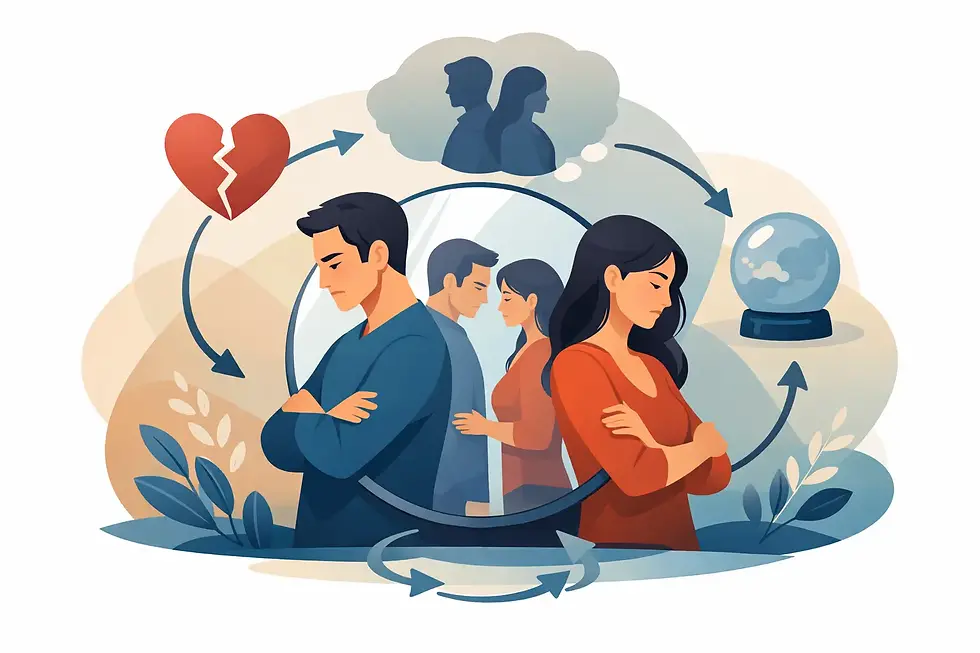
How many times have you felt like you’re reliving the same difficulty, with different people, at different times in your life? The same fear of abandonment, the same difficulty saying no, the same need to be perfect. It’s no coincidence. In psychology, these deep, recurring patterns of thought and feeling are called **schemas** — a concept developed by psychologist Jeffrey Young in the context of Schema Therapy (Young, Klosko, & Weishaar, 2003). In this article, we’ll look at five of the most common patterns that affect our relationships, how they’re connected to what we experienced in our early years, and what recent research shows about their relationship to anxiety and mood.
The insecurity of the connection
Some people have a hard time believing that someone will actually stick around, even when they show it every day. A simple delay in a text can immediately spark the thought, “Something is wrong.” A moment of closeness can be accompanied by the anxiety of when it will end.
This pattern, which Schema Therapy calls “Disconnection & Rejection,” has been linked to increased symptoms of social anxiety through automatic negative thoughts about self and others (Calvete, Orue, & Hankin, 2013). Often, this is due to an early experience where stability or warmth was not a given. The first step is usually to acknowledge the thought as it arises — “this is my old fear, not something that is happening now” — and gradually try to share what we need, rather than keeping it inside.
The difficulty of standing alone
Others have difficulty making even small decisions without consulting someone else first. They put off making choices for fear of making a mistake. They feel like they haven't yet found their own voice, separate from what others expect.
The domain of “Reduced Autonomy” has been found in a recent meta-analysis to be one of the strongest predictors of anxiety symptoms in adolescents and young adults (Tariq, Quayle, Lawrie, Reid, & Chan, 2021). This often stems from an environment that was either overprotective or did not provide enough support for learning to stand on one’s own. Small, daily steps of autonomous decision-making, without consulting anyone, gradually help build confidence in our judgment.
When the rules don't seem to apply to you
There is also the opposite pattern: difficulty tolerating “no” or delay. Anger comes easily when something doesn’t go the way we wanted. We start things with enthusiasm, but give up as soon as they become tedious.
In Young’s model, this corresponds to the “Reduced Boundaries” domain and often stems from a lack of firm boundaries early on, or from an attempt to compensate for an old sense of deprivation (Young, Klosko, & Weishaar, 2003). Practicing frustration tolerance—waiting a little longer before reacting, seeing something small through to completion—helps to gradually loosen this pattern.
When you put yourself last
Many people almost always put the needs of others before their own. They have a hard time saying no. They feel guilty if they take care of themselves, even when they really need to. Their value seems to depend on how useful or likable they are.
The “Other-Orientedness” domain has also been found to be significantly related to anxiety symptoms, especially when combined with a low sense of self-worth (Tariq et al., 2021). This is often learned early on: that love or acceptance only comes when we care for others. Small, incremental tests — a “no” to something small, an activity just for us — help us discover that our worth does not depend on constant giving.
When nothing is ever enough
Finally, there is the pattern of constant vigilance: focusing almost always on what could go wrong, the difficulty in relaxing without guilt, the harshly critical attitude towards ourselves, even when something went well.
Research in adults with depressive symptoms has shown that schemas associated with shame and harsh self-criticism play a significant role in maintaining depressed mood (Bishop, Younan, Low, & Pilkington, 2022). This is often formed in environments where mistakes were severely punished. Practicing self-compassion — pausing and acknowledging what went well before thinking about what was lacking — is a first, small step.
The first step is recognition
None of these patterns are character flaws. Research shows that patterns are not formed randomly, but are systematically linked to how our parents raised us, and can even be passed down from one generation to the next if they are not recognized (Sundag, Zens, Ascone, Thome, & Lincoln, 2018). The difficulty is that they often continue to operate automatically today, even when they no longer serve a purpose.
Recognizing a pattern is not the end of the journey — it is the beginning. The real work, how these patterns formed and how they can gradually change, is done through a careful, individualized treatment process. This article is for informational purposes only and is not a substitute for an individualized clinical evaluation.
**If you recognize yourself in any of these patterns, try the short interactive tool or book an initial couples therapy appointment to explore the issue together.**
Bibliographic References
Bishop, A., Younan, R., Low, J., & Pilkington, PD (2022). Early maladaptive schemas and depression in adulthood: A systematic review and meta-analysis. *Clinical Psychology & Psychotherapy, 29*(1), 111–130.
Calvete, E., Orue, I., & Hankin, BL (2013). Early maladaptive schemas and social anxiety in adolescents: The mediating role of anxious automatic thoughts. *Journal of Anxiety Disorders, 27*(3), 278–288.
Sundag, J., Zens, C., Ascone, L., Thome, S., & Lincoln, TM (2018). Are schemas passed on? A study on the association between early maladaptive schemas in parents and their offspring and the putative translating mechanisms. *Behavioural and Cognitive Psychotherapy, 46*(6), 738–753.
Tariq, A., Quayle, E., Lawrie, SM, Reid, C., & Chan, SWY (2021). Relationship between early maladaptive schemas and anxiety in adolescence and young adulthood: A systematic review and meta-analysis. *Journal of Affective Disorders, 295*, 1462–1473.
Young, JE, Klosko, JS, & Weishaar, ME (2003). *Schema therapy: A practitioner's guide.* Guilford Press.