Why am I stressed for no reason?
Updated: Aug 13
You might be sitting on the couch, nothing special has happened, and suddenly you feel a tightness in your chest, worry, or a tension that is not easily explained. If you are thinking “why am I anxious for no reason?”, this article was written precisely to put some order into this experience. Its purpose is to help you understand why anxiety often appears without an obvious external reason, how it is connected to your body, mind, and daily life, and what you can practically do when it happens. You will also see when this condition deserves closer investigation within a safe therapeutic context.
Why am I stressed for no reason when everything seems normal?
The short answer is that there is usually a reason, it's just not immediately apparent. Anxiety doesn't only trigger when there is a clear danger. It can arise from accumulated fatigue, from long-held tension, from unconscious thoughts, from pressure that you have learned to consider "normal," or from your body being on constant alert.
The brain doesn’t always wait for an objective threat to sound the alarm. It simply interprets something as a potential danger, even if you don’t consciously recognize it. This explains why someone can say “I have no reason to be worried” and at the same time feel intense anxiety, palpitations, or nervousness. The cognitive appraisal of a situation plays an important role in how we experience stress and anxiety (Lazarus & Folkman, 1984).
Simply put, anxiety is not a lie, nor an exaggeration. It is a true signal, even when its meaning is not immediately clear.
Anxiety without an apparent cause is not always "irrational"
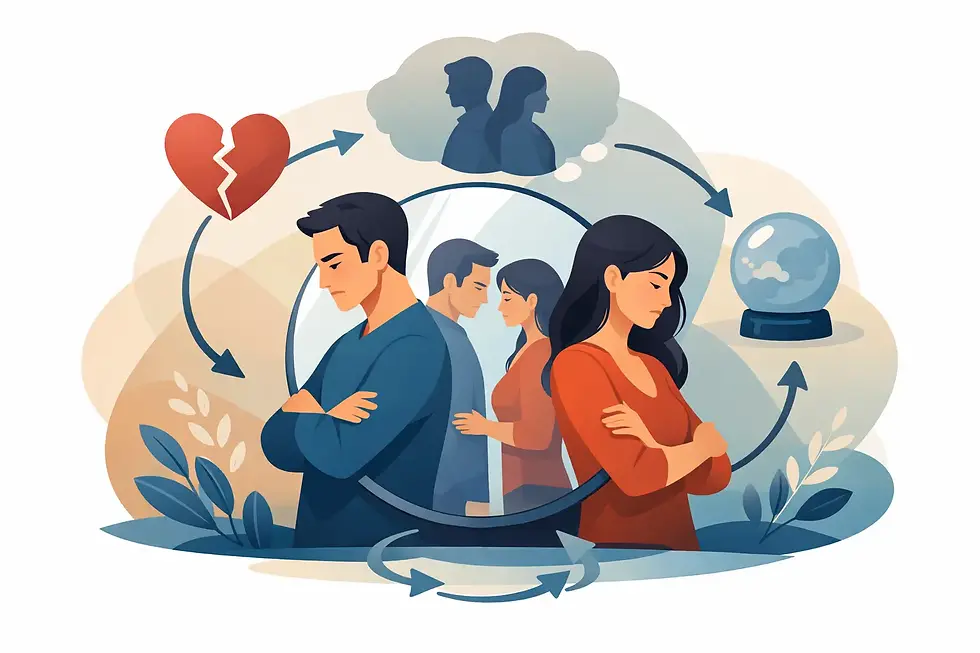
Many people fear anxiety more when they cannot explain it. This is where a second cycle begins: I feel anxious, I don’t know why, I worry about the anxiety itself, and so I intensify it. This mechanism is very common and has been described in the cognitive approach to anxiety difficulties (Clark & Beck, 2010).
There are days when the nervous system is already stressed. Lack of sleep, work overload, difficult conversations, loneliness, internal pressure to do everything right, even constant exposure to the news or screens, can keep the body on alert. Then a small trigger - or even no visible trigger - is enough to cause anxiety to appear.
This is especially common in people who have been operating for a long time "in the red." On the outside, they appear efficient. But on the inside, they have little space to process what they are feeling.
Possible reasons why you feel anxious for no reason
Accumulated stress that has not been released
Stress isn't just created by one big event. It's often the result of small, recurring stressors. Deadlines, financial uncertainty, family obligations, relationship difficulties, demands on yourself. When these become your daily routine, the body has a hard time recovering.
Suppressed or confused emotions
Sometimes anxiety isn't the main emotion. There may be underlying anger, sadness, fear of rejection, or insecurity. If you've learned not to give them space, they often appear disguised as tension, worry, or physical discomfort.
Body hypervigilance
When the body becomes accustomed to being on alert, it begins to constantly “scan” for threats. It pays more attention to its heartbeat, breathing, dizziness, tightness. This heightened awareness can heighten the sense of danger, even when there is no real immediate danger.
Perfectionism and high internal demands
There is also the stress that comes not from what is happening, but from how you believe you should respond. “I have to succeed,” “I must not make mistakes,” “I cannot get tired” creates constant internal pressure. Often this does not sound like stress. It sounds like a stern voice inside you.
What does stress look like on the body?
Unreasonable anxiety isn't just a thought. It's also a physical experience. It can manifest as a racing heart, a knot in your stomach, tightness in your chest, sweating, shallow breathing, trembling, difficulty concentrating, or a feeling that something bad is going to happen.
These symptoms are unpleasant, but they don’t necessarily mean you’re losing control. They often indicate that your nervous system is overactive. The more you are frightened by the symptoms, the more persistent they may become. The relationship between physical sensations and their catastrophic interpretation is central to the maintenance of anxiety (Barlow, 2002).
What to do the moment it appears
At that time, the goal is not to forcefully "make" the anxiety go away. It usually helps more to reduce the intensity of the alarm. Start with something simple and specific: put your feet on the floor and silently name five things you see around you. This helps the brain focus on the present.
Then, give your breath some space without forcing it. A calm exhalation that is slightly longer than your inhalation often helps more than trying to “breathe properly.” Saying to yourself, “What I feel is anxiety, not danger,” reduces the confusion between signal and threat.
If anxiety occurs frequently, keep a brief note for a few days: when it started, what preceded it, what you thought, what you felt in your body. Very often, the "for no reason" begins to take on a pattern.
Why do I get anxious for no reason at night or when I'm relaxing?
This is one of the most common and misunderstood patterns. Many people feel more stressed when they finally stop. While you're busy, your attention is focused outside. When the pace drops, whatever was left in the background becomes louder.
That's why many people say that as soon as they lie down, their minds start racing. It doesn't mean that relaxation is causing the problem. It means that the quiet makes room for what has been holding back all day.
A fine distinction is needed here. If you try to fill every minute so as not to feel, you may temporarily feel relief, but in the long run the anxiety only intensifies. Conversely, when you learn to safely tolerate a little internal contact, the system calms down more steadily.
When is more systematic help needed?
You don't have to wait until things "get really bad" to seek help. If anxiety recurs frequently, if you start avoiding situations, if it affects your sleep, work, relationships, or your sense of self, then it's worth looking at it more systematically.
Psychotherapy can help not only reduce the symptom, but also understand what is maintaining it. Sometimes the underlying difficulty is overexertion. Other times it is unresolved relationships, internal self-criticism, or a pattern that has been repeated over time. Not everyone is the same, so the same approach does not help everyone. This is why careful assessment is valuable before jumping to conclusions.
For people living in Athens with its demanding pace or for Greeks abroad who carry additional pressure to adapt, "unreasonable stress" is often ultimately linked to very specific internal and interpersonal factors.
A more useful question than "why is this happening to me?"
The question “why am I stressed for no reason?” is completely understandable. But sometimes it traps you, because you’re looking for a perfect, immediate explanation. It’s often more helpful to ask: “What could this stress be trying to show me?” and “what’s fueling it in my life right now?”
This shift doesn't blame you. It helps you move from feeling helpless to understanding. And when there is understanding, there is room for change.
If you're feeling like stress is hitting you without warning right now, try not to confront it like it's the enemy. It's often an intense, uncomfortable way for your body to ask you to listen a little more carefully.
Bibliography
Barlow, DH (2002). Anxiety and its disorders: The nature and treatment of anxiety and panic (2nd ed.). Guilford Press.
Clark, DA, & Beck, AT (2010). Cognitive therapy of anxiety disorders: Science and practice. Guilford Press.
Lazarus, RS, & Folkman, S. (1984). Stress, appraisal, and coping. Springer.
American Psychiatric Association. (2013). Diagnostic and statistical manual of mental disorders (5th ed.). American Psychiatric Association.