When one withdraws and the other pushes: the cycle that exhausts couples
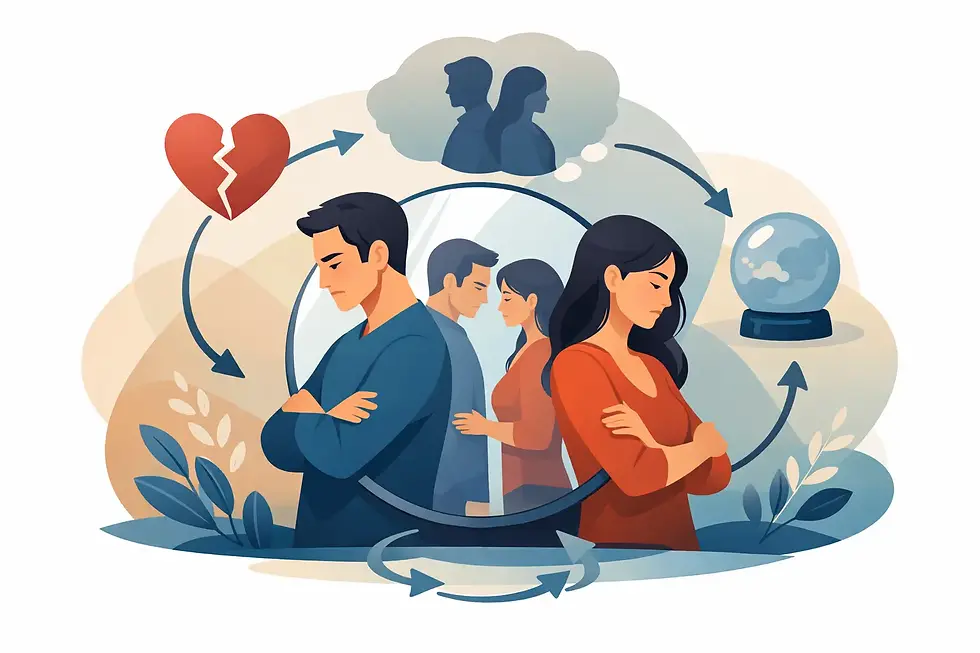
Psychotherapy literature describes it as the demand-withdraw cycle, and it’s one of the most studied and most fixable patterns in couples therapy. This article explains how it works, why both parties have good intentions, and why the solution lies in the couple’s dynamics — not who is “at fault.” When you feel like every attempt to communicate with your partner ends in either silence or tension, it’s easy to believe that the problem is the other person’s character — or your own. In reality, it’s often not a character problem, but a cycle: the more one withdraws, the more the other presses for a response, and the more one presses, the more the other withdraws.
It's not a face problem, it's a context problem
One of the most common pitfalls in this cycle is blame-seeking: “if he/she would change, it would be solved.” Clinical experience suggests otherwise—the demanding-withdrawal cycle is a relational phenomenon, not an individual flaw. Both roles, the restrained and the pushy, have their own internal logic and often good intentions behind them. The issue is not which of the two needs “fixing,” but how their interaction—the context they create together—feeds the cycle. This shift, from “who’s to blame” to “what’s going on between us,” is often the first and most healing step in couples therapy.
The logic behind avoidance
Anyone who withdraws from a difficult conversation is usually not doing so out of indifference. Often, the internal belief is something like, “If I bring this up now, there will be conflict, and I don’t want to risk the relationship.” Avoidance, in other words, is experienced as protection, not indifference. The problem is that the issue rarely goes away when it is avoided—it is simply postponed, and often returns in a bigger way.
The void that is filled with fear
Silence, however, is never truly empty. When one partner does not explain what they are thinking or feeling, the other tends to fill that void themselves—and usually not with the most favorable explanation. “He/She doesn’t count on me,” “He/She is hiding something,” “I don’t care about him/her anymore” are typical interpretations that arise not because they are necessarily true, but because the human mind resents uncertainty and tends to close it quickly, often with the worst-case scenario (Baumeister, Bratslavsky, Finkenauer, & Vohs, 2001, on the stronger weight of negative experiences in cognitive processing).
An example. Imagine a couple where she is waiting for her partner to return from a visit to his parents. When he returns silently, she asks what happened; he replies “nothing, everything is fine” and changes the subject. Without any further information, she might conclude: “Something was said against me and he’s not telling me.” The assumption may be right or wrong—the point is that it went from assumption to certainty in seconds, without any confirmation.
How does it scale?
The partner who feels that he is not getting an answer, of course, does not remain passive. He presses harder, asks again, sometimes with intensity — precisely because he wants to close the gap described above. This pressure, however, confirms to the partner who is withdrawing the very fear that made him withdraw in the first place: “Look how he reacts, he does not understand... It is a good thing I did not speak, if I had spoken, there would have been a mess.” So he withdraws even more, the pressure increases again, and the cycle feeds itself. The classic research by Christensen and Heavey (1990) showed that this pattern depends not so much on “who is like this” as on who wants change on a particular issue — that is, it is more dynamic than character, exactly as described above.
A second example , in a different context: a father decides to spend the weekend with his daughter from a previous marriage, without discussing it with his new partner in advance. She experiences it as a degradation of their relationship, while he simply took for granted his right to see his child. Instead of discussing it openly, she withdraws, offended, he feels wronged that his intention is not recognized, and tension grows around an issue that could have been resolved with a simple clarification.
The point where the interpretation gets stuck
There is a second level of difficulty, just as important: the distance between what actually happened and what it means. One partner may make a decision—to spend time with a child, with friends, with work—and the other may automatically translate that decision into a judgment about the relationship: “I’m not a priority,” “I don’t count.” The cognitive approach calls this step “automatic thinking” (Beck, 1979): an interpretation that passes so quickly that we often experience it as a fact rather than an assumption. The job is not to stop feeling—it’s to learn to distinguish fact from interpretation, before the interpretation determines our next move.
Investigative curiosity as an antidote
The tool that can break this rapid transition from fact to certainty is called, in therapeutic parlance, inquisitive or curious stance — the attitude of keeping an interpretation open, as a possibility to be explored, rather than immediately closing it as a conclusion.
In practice, this means replacing internal statements-certainties with statements-assumptions. “He doesn’t count on me” becomes “something about that bothered me — I want to understand what it really meant to him/her.” The thought "there will be a conflict if I speak” becomes “I don't know yet how this conversation will play out — let me try saying something small and see”. The thought “he is influenced by his best friend” becomes “he might have some influence over him, but how will I find out how much and to what extent...”. The difference seems subtle, but it radically changes what you do next: a certainty leads to defense or attack, an assumption leads to a question.
This attitude is not the same as ignoring what you feel. The feeling remains real and worth listening to; what changes is the certainty with which you translate it into fact for the other person. Investigative curiosity, then, does not mean “don’t trust your gut” — it means “add a step between gut and conclusion”: ask before you interpret, listen to the answer, and then decide what what happened really means.
Gottman and Silver's (1999) study shows that couples who maintain this open, curious attitude toward each other's inner experience—rather than assuming they already know it—have significantly more stable relationships over the long term, regardless of how often they disagree. It's not the absence of disagreement that protects the relationship, but the way each side approaches what they don't yet understand in the other.
How to separate strategy from fear
A useful test, for both avoiders and pushers, is to see whether your behavior is actually a choice or an automatic reflex. Those who are truly strategic in handling a situation change tactics depending on the facts—sometimes waiting, sometimes responding immediately. Those who operate out of fear almost always make the same move, no matter what the stakes are. A simple question helps to see for yourself: “The last time I could have put off something difficult but chose to deal with it right away—when was that?” If an example is not readily available, then it is probably not a choice but the execution of a well-established stress mechanism.
There is a similar test for the pressure side: the question is not whether the tension “succeeds” in the short term — it is whether it brings what you really want. A “yes” given to stop the pressure is not the same as a “yes” given because someone was convinced. The former needs to be constantly re-guarded; the latter holds on its own. The question worth asking yourself is: “Do I want a yes that was won through pressure, or a yes that was given because the other person really listened to me?” — because only the latter brings the feeling that one is really looking for: that one is being counted on, not that one has simply given in.
What really needs to change?
The encouraging finding of research on couples is that neither role needs to be “extinguished” to break the cycle (Gottman & Silver, 1999). The withdrawer does not need to become confrontational; he needs to learn to state a position before withdrawing—even a sentence, even a vague one, as long as he does not remain completely silent. The pusher does not need to become less assertive; he needs to learn to hold an interpretation as a hypothesis for a little longer before turning it into a certainty and acting on it.
In other words: the point is not for one to become like the other, but for both to add an intermediate step to their automatic reflex — curiosity before interpretation, position before avoidance. And this, precisely because it is a problem of context and not of person, is best worked on when both are involved in the process, rather than one trying to “fix” the other alone.
When is it worth asking for help?
If you recognize this cycle in your own relationship, it doesn't necessarily mean that something is irreparably broken — it means that there is a specific, studied pattern that can be systematically worked through, usually faster than you imagine when you're in it. Couples therapy provides exactly the space and structure to do just that: to understand each other's role in the cycle, without having to prove who is right.
Bibliographic References
Baumeister, RF, Bratslavsky, E., Finkenauer, C., & Vohs, KD (2001). Bad is stronger than good. Review of General Psychology, 5 (4), 323–370.
Beck, AT, Rush, AJ, Shaw, BF, & Emery, G. (1979). Cognitive therapy of depression . Guilford Press.
Christensen, A., & Heavey, CL (1990). Gender and social structure in the demand/withdraw pattern of marital conflict. Journal of Personality and Social Psychology, 59 (1), 73–81.
Gottman, JM, & Silver, N. (1999). The seven principles for making marriage work . Crown Publishers.