Ways of Managing Anger in a Relationship That Actually Help
Updated: Aug 13
An intense disagreement can start over something small — an unanswered message, a comment about finances, tiredness, or the housework — and within minutes turn into a conflict that leaves both people hurt. Ways of managing anger in a relationship aren't about making anger disappear. Anger often signals that a need, a boundary, or a disappointment needs attention. The goal is to express it without insults, threats, or silent withdrawal. In this article you'll see how to recognize escalation, what you can do in the moment of tension, and how a difficult conversation can gradually become safer and more meaningful.
Why Anger Escalates So Fast in a Relationship
In close relationships, we don't just react to the other person's words — we react to what we believe they mean: "they don't value me," "they don't respect me," "here I am, alone again." When there's fatigue, work pressure, anxiety, or old disappointments in the mix, the brain can interpret an ambiguous behavior as a threat. The tone rises, attention narrows, and the desire to prove we're right takes over the need to understand.
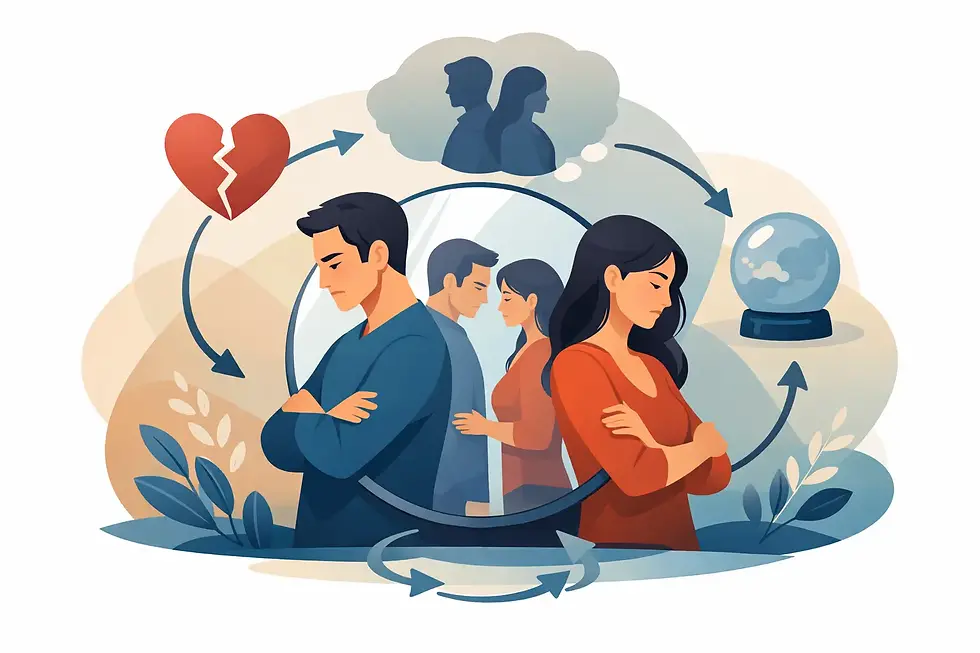
A repeating cycle often forms: one partner pushes for a response, the other withdraws to protect themselves, and that withdrawal gets experienced as indifference. It doesn't mean one person is "the angry one" and the other "the calm one." Usually both are trying, in different ways, to manage insecurity or frustration. Relationship research shows that contempt, chronic defensiveness, and avoiding conversation — when they become fixed patterns — significantly damage a couple's connection (Gottman & Levenson, 2000).
Ways of Managing Anger in a Relationship in the Moment of Tension
The most useful skill isn't finding the perfect response in the middle of conflict. It's recognizing early enough that the conversation has moved past the point where you can listen and be heard.
Recognize your own personal warning signs
Anger shows up in the body first: a clenched jaw, fast breathing, a racing heart, tension in the shoulders, or the urge to interrupt. For others it shows up as coldness, sarcasm, or the thought "there's no point talking." If you learn your own signs, you gain a few valuable seconds before saying something that doesn't actually reflect what you want to express.
Try naming the experience without blame: "I'm getting really worked up right now, and I'm afraid I'll say something harsh." This phrase doesn't resolve the issue, but it changes the frame. Instead of opponents in a dispute, you become two people acknowledging that the tension needs care.
Take a pause, with an agreement to return
A pause isn't abandonment or punishment. It's a way to let physical arousal settle so that thinking can return. The difference lies in clarity: instead of "leave me alone," say "I need 30 minutes to calm down, and I'll be back at 8:30 so we can continue."
During the pause, avoid mentally preparing your next accusation. Do something that regulates the tension: walking, slow breathing, a shower, or jotting down what upset you and what you need. The ability to regulate emotion doesn't mean suppressing it — it means choosing when and how to act, instead of being driven by impulse (Gross, 2015). DBT techniques, such as regulating intensity before we react, can also be applied in moments of intense anger within a relationship (Linehan, 2015).
Describe the event, the emotion, and the request
Generalizations like "you never help" or "you always dismiss me" trigger defensiveness, even when there's legitimate disappointment behind them. A more effective approach is a three-part statement: what happened, how it affected you, and what you're asking for.
For example: "When our plans changed without us discussing it, I felt like I wasn't taken into account. Next time, I'd like you to tell me before deciding." It's not a magic formula, and it doesn't guarantee the other person will agree — but it offers a specific opening for response, instead of opening up a list of old grievances.
Listen without necessarily agreeing
Listening doesn't require admitting you're to blame for everything. It requires showing that you understand the other person's emotional logic. A simple reflection can noticeably lower the tension: "I hear that you felt alone when I didn't answer. I didn't mean to ignore you, but I understand why it bothered you."
Pay attention to the difference between explaining and dismissing. "I had a lot of work" can be useful information. "I had a lot of work, so you're overreacting" shifts the conversation from the fact to invalidating the feeling. When one partner feels they don't have to fight to prove they're hurting, they're more likely to also hear the other's perspective.
Set boundaries around behaviors that hurt
Managing anger doesn't mean tolerating every form of expression. Insults, humiliation, threats, shoving, breaking objects, or controlling the other person aren't "just nerves." A clear boundary is needed: "I'll discuss this, but I won't stay in a conversation with shouting and insults. I'll come back when we can talk differently."
A boundary has value when it's followed through consistently and when it concerns your own action, not an attempt to control the other person. You can't force a partner to calm down. But you can decide when you participate in a conversation and under what conditions. If there's fear for your physical safety, the priority is to remove yourself from the tension and seek immediate support from trusted people and the appropriate services.
Talk about the pattern when things are calm
The most important agreements aren't made in the middle of a fight. Choose a calm moment and discuss what usually happens: What topics trigger you? How does each of you know you need a break? How long should the pause last? Which words or behaviors are off-limits?
A short weekly 20-minute "check-in" can also help. Each person shares something they appreciated, something that was difficult, and one small, specific request for the coming week. You don't need to turn the relationship into a constant evaluation — but steady, gentle communication reduces the chance that small grievances pile up until they explode.
For couples with demanding jobs, children, or distance due to living abroad, time and exhaustion are real constraints. Saying "we need to communicate better" isn't enough. You need to agree on when there's actually attention available and when a conversation needs to wait. Resolving an issue at 11pm, after an exhausting day, often costs more than it delivers.
When Extra Support Is Needed
If the same fight keeps coming back without change, if silence lasts for days, or if anger has become the main way you communicate, individual psychotherapy or couples therapy can offer a safe framework for exploring the cycle. The cognitive-behavioral approach helps identify the automatic interpretations that feed the tension and practice more functional responses. Couples therapy doesn't decide who's right — it creates space for each person to be heard on what they're protecting when they get angry, and what they need to feel connected again.
Anger doesn't need to become the voice of your relationship. Every time you take a pause, speak more clearly, or return to a difficult conversation with respect, you build a little more trust — not perfect, but real.
References
Gottman, J. M., & Levenson, R. W. (2000). The timing of divorce: Predicting when a couple will divorce over a 14-year period. Journal of Marriage and Family, 62(3), 737-745.
Gross, J. J. (2015). Emotion regulation: Current status and future prospects. Psychological Inquiry, 26(1), 1-26.
Linehan, M. M. (2015). DBT skills training manual (2nd ed.). Guilford Press.