Love alone is not enough: what keeps a relationship alive
Updated: Aug 13
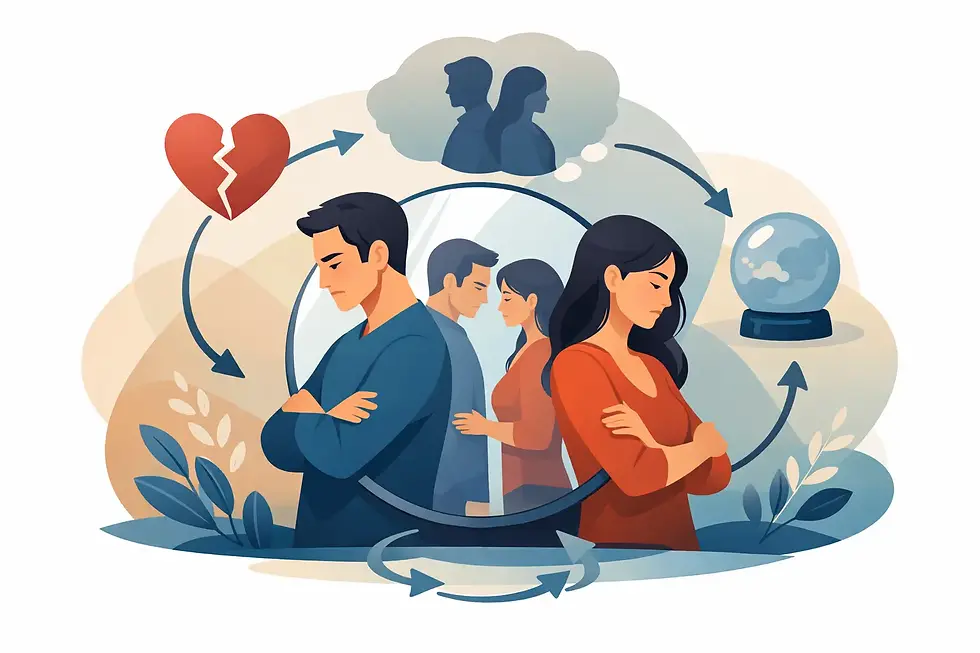
“All you need is love.” The Beatles’ phrase sounds beautiful, romantic, and almost magical. Many people grow up believing that if there is enough love between two people, everything else will fall into place. Differences will be smoothed out, problems will be solved, difficulties will be overcome. The reality, however, is more complex. Love is necessary. But it is not enough on its own.
Love can bring two people together. It can create tension, passion, the feeling that we have found “our other half.” What it often fails to do is keep the relationship alive when the inevitable challenges of everyday life arise: different ways of handling conflict, financial pressures, personality changes over time, childhood traumas that resurface, different needs for closeness or independence.
Because love is not enough
First, love does not equal compatibility. You can love deeply someone with whom you do not share core values, life goals, or ways of communicating. A strong emotional connection can make you overlook important differences for a long time. Over time, however, these differences tend to become more apparent and create friction.
Second, love doesn't automatically solve problems. When two people disagree about money, child rearing, sex life, or family boundaries, the feeling of love can make the confrontation more painful, not necessarily easier. Without conflict management skills, love often turns into frustration or bitterness.
Third, love as an emotion is variable. Passion and intense romantic attraction have a natural duration. What remains after that is choice, commitment, and daily action. As Erich Fromm wrote, love is not just a feeling that “happens to us.” It is a capacity and an action. It is the decision to actively care for the well-being of another, even when we do not feel it intensely.
In my office, I often see couples who come in saying things like, “I don’t get it, we still love each other, but why do we fight all the time? What’s not working?” And usually, when we start to unravel what they mean, love is indeed there — but it has stopped being enough as the sole “strategy” for the relationship. A couple can love each other deeply and yet have no common way of handling a disagreement without ending in silence or tension. The work there isn’t about “finding love again” — it usually hasn’t gone anywhere. It’s about building the skills that love itself doesn’t teach: how to listen to someone without already having your answer ready, how to express a need without sounding like an accusation, how to come back to each other after a difficult moment.
What is needed beyond love?
Relationships that last over time are usually based on a series of elements that work in parallel with love:
Respect and emotional safety
Feeling like you can be yourself without fear of criticism, ridicule, or rejection. John Gottman's research has shown that contempt and defensiveness are among the strongest predictors of relationship failure. In contrast, respect and the ability to let down your defensiveness create safety. Attachment theory shows that how we feel secure or insecure in a relationship usually echoes patterns learned long before we met our partner (Mikulincer & Shaver, 2016).
Communication
Not just talking, but really listening. Expressing needs without accusations. Being able to say “I feel hurt” instead of “you never…” Many relationships fail not for a lack of love, but for a lack of effective communication. Cognitive-behavioral couples therapy often works with the shared "schemas" the couple has built together, beyond how each partner thinks individually (Dattilio, 2010).
Self-awareness and personal responsibility
The more we understand our own patterns, fears, and defenses, the less we burden our partner with them. Love becomes healthier when it is accompanied by the ability to recognize when we are reacting from old wounds rather than the present situation.
Shared values and direction
You don't have to be the same in everything. But you do need to agree on basic issues: how you want to live, what family means to you, how you deal with difficulties, what you consider important.
Daily effort and small actions
Love is maintained through habits: being interested in the other person's day, acknowledging their effort, being willing to mend the cracks after a disagreement. Relationships that last are not those that don't have problems, but those where both people know how to get back to each other.
Love as a foundation, not as a panacea
The idea that “love solves everything” can become a trap. It leads to unrealistic expectations and disappointment when reality turns out to be more complicated. It can also keep people in relationships that are harmful, on the grounds that “we still love each other.”
The healthy perspective is different: love is the foundation and the motivation. What builds and sustains the relationship is respect, communication, emotional maturity, shared effort, and the ability to grow together without losing ourselves.
In long-term relationships, love does not remain the same as it was in the first few months. It transforms. It becomes calmer, deeper, more conscious. And this transformation does not happen automatically. It requires presence, willingness, and work.
Ultimately, the question is not whether love is enough. The question is whether we are willing to do what love needs to endure: to accompany it with respect, effort, honesty, and constant choice of the other. Because love can ignite the flame. What keeps it alive is conscious, daily action.
Bibliographic references
Dattilio, FM (2010). Cognitive-behavioral therapy with couples and families: A comprehensive guide for clinicians. Guilford Press.
Gottman, JM, & Silver, N. (2015). The seven principles for making marriage work: A practical guide from the country's foremost relationship expert (Revised and updated ed.). Harmony Books.
Mikulincer, M., & Shaver, PR (2016). Attachment in adulthood: Structure, dynamics, and change (2nd ed.). Guilford Press.