Jealousy is not a problem, it's the message
When you feel a pinch because your man took a while to respond, laughed at someone else, or kept something to himself, the first impulse is often to control, question persistently, or walk away. But jealousy isn't the problem—it's the message: how to decode it before it destroys you is a question that's less about whether you're "right" to be jealous and more about what that feeling is trying to tell you. The purpose of this article is to help you separate the feeling from the reactions that can damage the relationship, recognize what triggers it, and respond with more clarity, security, and self-respect.
Jealousy is not the problem, it's the message
Jealousy is a complex emotion. It doesn't usually come alone: it can involve fear of loss, anger, shame, insecurity, or a feeling of not being enough. It doesn't in itself prove that something bad is happening in the relationship. But it does indicate that something inside you perceives a potential threat to an important bond.
The crucial point is that jealousy is not a reliable “truth detector.” It can arise because there is genuine ambiguity, a breach of agreement, or a lack of honesty. But it can also be triggered by a past experience of rejection, low self-esteem, or a thought that passes so quickly that it seems like a fact: “If he’s interested in someone else, then I’m not worthy.”
Research describes jealousy as a reaction to a perceived threat to a valued relationship, not exclusively to a proven threat (Parrott, 1991). This distinction matters. The emotion is worth listening to. But its interpretation needs scrutiny.
When does jealousy become destructive?
It's not the feeling of jealousy that usually destroys trust. It's what we do to temporarily relieve it. Seeking reassurance once in a while can be a human need. Systematically checking phones, demanding locations, questioning the other person, or limiting their contact is different. It may reduce anxiety for a few minutes, but it trains your mind to seek more and more reassurance.
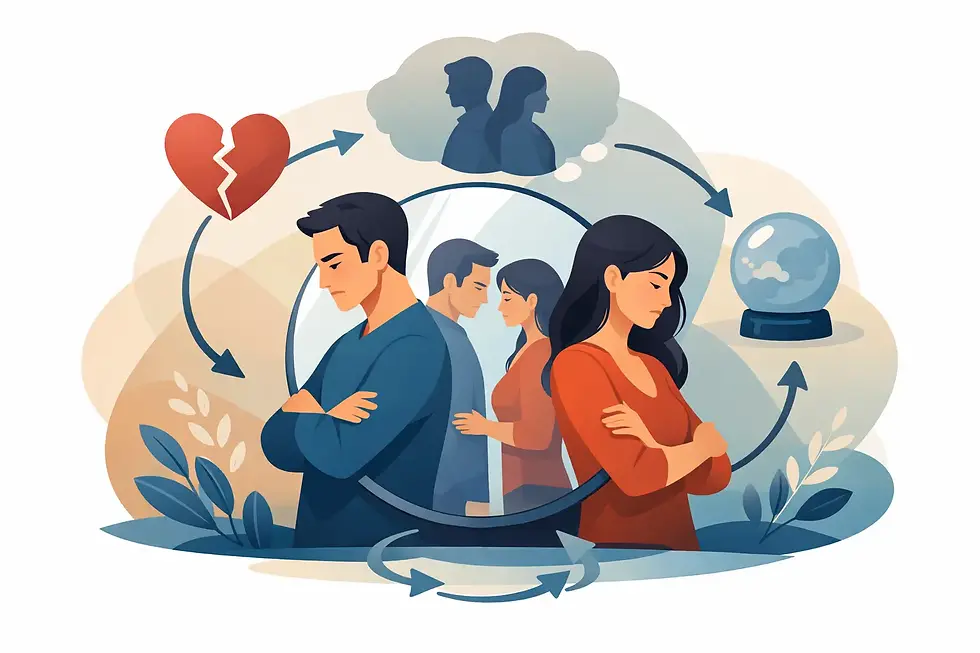
In the cognitive-behavioral approach, this looks like a vicious cycle: a stimulus triggers a threatening thought, the thought causes a strong emotion, and the tension leads to control or blame. Short-term relief reinforces the behavior, so the next time the jealousy appears faster and with greater intensity.
The destructive side of jealousy is not limited to romantic relationships. It can appear in friendships, family, or even work environments, when attention, recognition, or closeness seem to be going elsewhere. In each context, the key question remains: “What am I afraid of losing and what am I drawing a conclusion about myself?”
Distinguish the facts from the story that the mind makes up
A useful first step is to write the situation in two columns. In the first, put only observable facts: “He didn’t reply for four hours.” In the second, put the interpretation: “He ignores me,” “He’s with someone else,” “He doesn’t count on me.” This doesn’t mean that the second column is necessarily wrong. It means that it’s an assumption, not a given.
Then ask yourself: What other scenarios are likely to be true? What evidence do I have for and against my thinking? If the same thing were happening to a friend of mine, what would I say to them? This process doesn't invalidate the feeling. It does, however, reduce the likelihood that tension will make decisions for you.
Decode the message behind jealousy
Beneath jealousy is usually an unexpressed need. Perhaps you need more closeness, consistency, transparency, affirmation, or clearer agreements. Perhaps you need to rebuild your self-confidence so that your worth doesn't seem to depend on another person's attention.
Attachment theory helps us understand why some people are more strongly triggered by distance or ambiguity. When there is a heightened fear of abandonment, small signs of detachment may be experienced as urgent. When there is a fear of excessive closeness, jealousy may be combined with withdrawal or coldness. These are patterns that can be recognized and changed, they are not an identity or “character” (Mikulincer & Shaver, 2016).
Try completing the sentence: “When this happens, I’m afraid that…” Don’t just say “he’ll cheat on me.” Go a level deeper: “he’ll leave me,” “I’ll prove I’m not enough,” “I’ll relive an old betrayal,” “I won’t have control.” That’s usually where the real message lies.
How to react without betraying yourself
Before you text, make an accusation, or decide to walk away, give yourself a short pause. Notice what’s happening in your body, name the emotion, and try not to act on it. This skill is key in DBT: it doesn’t ask you to suppress the emotion, but to create space between the emotion and the action (Linehan, 2015).
After the pause, choose a communication that describes rather than accuses. Instead of “You always make me jealous,” you could say, “When I don’t hear from you for hours after we’ve talked, I get stressed and start to play out negative scenarios. It would help if we agreed on how we communicate when we’re busy.” The difference isn’t just linguistic. In the first version, the other person is asked to defend themselves. In the second, they’re asked to understand a need and participate in a solution.
At the same time, you need to tolerate some uncertainty. No relationship can offer an absolute guarantee that there will never be disappointment. Trying to eliminate all doubt through control comes at a high cost: it reduces freedom, warmth, and ultimately trust for both of you. Accepting uncertainty is not giving up. It is a choice to live by your values - honesty, dignity, reciprocity - even when the emotion demands immediate certainty.
When jealousy indicates a real problem in the relationship
Self-observation shouldn't turn into self-doubt. If there are repeated lies, violation of shared boundaries, downplaying your concerns, or a reversal of responsibility every time you raise a reasonable issue, jealousy may indicate that you need to take a closer look at the dynamics of the relationship.
Healthy coping is neither “it’s my fault for being jealous” nor “it’s your fault for feeling this way.” It’s a more mature question: “Is there something I need to change in the way I interpret and react, and is there something that needs to change in the way we relate?” Relationship quality is linked to partners’ ability to manage conflict, respond to each other’s needs, and repair cracks after difficult times (Gottman & Silver, 2015).
When is it worth asking for support?
If jealousy often leads to checking, outbursts, isolation, persistent anxiety, or repeated arguments, individual work or couples therapy can provide a safe framework. Cognitive-behavioral therapy helps identify the thoughts and behaviors that perpetuate the cycle, while ACT and DBT approaches cultivate greater resilience to the difficult emotion and more effective communication.
You don't have to wait until you're at your limit to deal with it. Jealousy can be an opportunity to learn not only how to protect a relationship, but also how to stand firmer in it. The next time it comes up, instead of asking, "How do I get you out?", try asking, "What are you trying to protect, and what is the most honest way for me to take care of it?"
Bibliographic references
Gottman, JM, & Silver, N. (2015). The seven principles for making marriage work (Revised and updated ed.). Harmony Books.
Linehan, MM (2015). DBT skills training manual (2nd ed.). Guilford Press.
Mikulincer, M., & Shaver, PR (2016). Attachment in adulthood: Structure, dynamics, and change (2nd ed.). Guilford Press.
Parrott, WG (1991). The emotional experiences of envy and jealousy. In P. Salovey (Ed.), The psychology of jealousy and envy (pp. 3-30). Guilford Press.