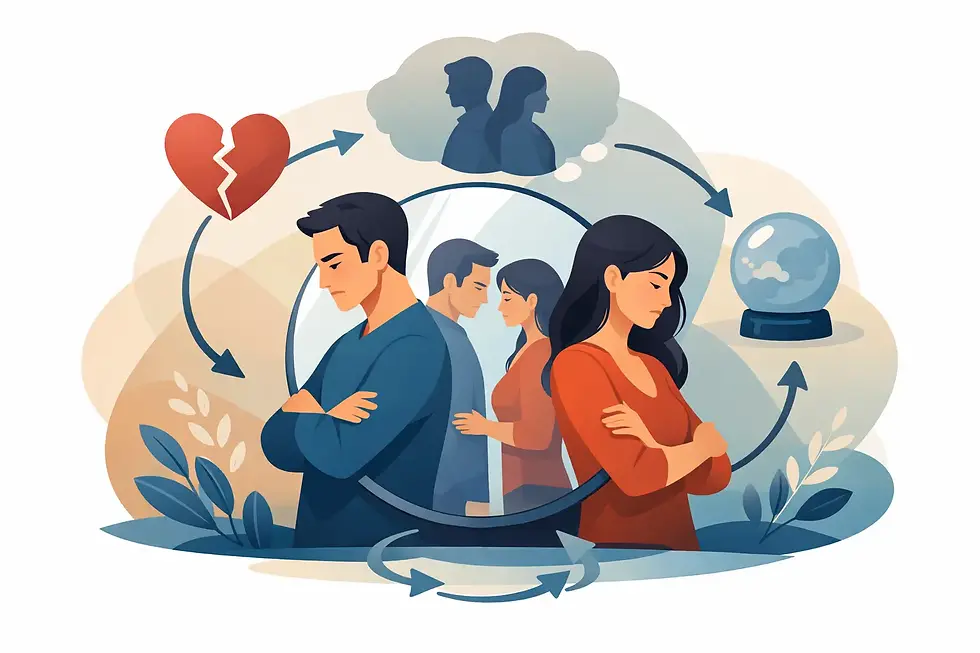
How to love yourself when they tell you to "find someone"
There comes a time when you hear “when are you going to find someone?” for the umpteenth time and you feel like you have to apologize for your life. Not because you did anything wrong, but because others seem to view being in a relationship as proof of your worth. If you’re wondering how to love yourself when everyone is telling you “you need to find someone,” the first thing you need to know is this: your worth is not measured by whether you’re in a relationship or how convincingly you show that you’re not affected by the pressure.
This pressure isn't always obvious. It can come as a joke at the family dinner table, as well-meaning advice from friends, as comparisons to others who have "moved on." It can even come from within, when you start to believe that something is missing from you because a partner is missing from your life. That's where the relationship with yourself begins to be damaged.
What really hurts when they tell you "you need to find someone"
It's usually not the phrase itself that hurts. It's the message it carries: "the way you are now, it's not enough." This message triggers deeper fears - rejection, loneliness, feeling left behind. If you're already going through a period of anxiety, sadness , or doubt, social pressure can touch very sensitive spots.
Research in the psychology of self-esteem shows that when your sense of worth is contingent on your romantic relationship—what researchers call relationship-contingent self-esteem —the result is increased anxiety, an “obsessive” preoccupation with the relationship, and reduced autonomy (Knee et al., 2008; Crocker & Park, 2004). In other words, when your worth is “hung” on whether you have a partner, you don’t gain peace of mind—you gain insecurity.
This doesn't mean we don't need relationships. We do. But it does mean that the desire for connection is one thing, and the belief that without a partner you are not worthy enough is another. You can want a relationship and at the same time not abandon yourself in the search for it. You can be sad that the person you want hasn't come along yet and at the same time not translate this absence as a personal failure.
It's also worth noting something that research confirms and that is often overlooked: people in unhappy marriages have worse mental health outcomes than single people. The relationship itself is not protective — its quality is.
How to love yourself when everyone tells you "you need to find someone"
Self-love is not a motto or an obligation to feel good every day. It is a practical attitude towards yourself, especially on the days when you doubt yourself. It starts with the way you talk to yourself.
If every time you hear pressure you think, "They must be right, there's something wrong with me," then your internal dialogue becomes an extension of the outside voices. Try changing the wording slightly. Not to something exaggerated like "I'm perfect the way I am," if that doesn't ring true. But to something more solid and honest: "Not being in a relationship right now doesn't diminish my worth," or "I can want a partner without invalidating myself."
This sounds simple, but it's not. The brain is affected by repetition. When you systematically change the way you name your experience, the way you experience it gradually changes.
Separate desire from addiction
It is healthy to want a relationship. It is not healthy to believe that only through it you will be complete. The difference is visible in your thoughts. Desire says “I would like to share my life with someone.” Dependence says “if I don’t find someone, it means something is not worth it to me.”
When these two are confused, you start pursuing relationships out of fear rather than choice. You’re more likely to tolerate ambiguity, superficial interest, or belittling behaviors just so you don’t feel alone. Research confirms that people with high relationship-contingent self-esteem tend to behave in ways that serve the relationship at the expense of their own needs—precisely because their self-esteem depends on it (Holden, 2018).
Self-love helps you distinguish when you approach a person because they suit you and when you're trying to fill a value gap.
Set boundaries without apologizing.
You don't need to answer every intrusive question in detail. A calm "when I have something to share, I will" or "for now, I'm focusing on myself" will do. Setting boundaries isn't rude. It's a way to protect your mental energy from repetitive comments that wear you down.
If you have trouble setting boundaries , it's often not a weakness of character. You may have learned that in order to be loved, you have to be accommodating, available, and always willing to explain yourself. But that can be very tiring. Mature relationships can withstand clear boundaries.
Loneliness is not always the enemy
One of the most difficult things is to distinguish loneliness from solitude. The former can become a place of calm, contact with your needs, regrouping. The latter hurts because it is experienced as evidence of abandonment. They are not the same.
If you fill every empty night with panic, maybe you're not so much afraid of being alone as what it means for your self-image. That's where work needs to be done. Not to learn to do everything yourself, but to stop seeing silence as a condemnation.
Sometimes it helps to notice when you feel this pressure the most. After scrolling? At the holidays? After visiting family? When you identify your triggers, you can better organize your self-care instead of feeling like the emotion is overwhelming you out of nowhere.
Self-love in practice, not just in theory
Self-love is seen in small, repetitive choices. In whether you rest when you're exhausted. In whether you say no when you're stressed. In whether you allow yourself to want affection without shaming yourself for it. And in whether you stop comparing your inner reality to the edited images of others.
In practice, it's worth building a life that doesn't wait to begin when a partner shows up. This doesn't mean pretending you don't miss a relationship. It means investing in other pillars of identity: friendships, work, creativity, your body, rest, personal values. The more pillars your life has, the less likely you are to collapse when one area hurts.
If you feel like you’ve learned to see yourself only through the eyes of others, a simple exercise can help. At the end of the day, write down two things you appreciated about yourself and one thing that made you struggle, without being offensive. Not “I was a mess again.” But “I struggled with doubt today, and I tried my best.” This shift from criticism to observation is essential—and it’s the core of what psychologist Kristin Neff calls self-compassion: the ability to observe our thoughts and feelings with an open mind, without getting overwhelmed by them.
When the need for a relationship hides old wounds
Not everyone has the same difficulty with being single. For some, the pressure to "find someone" taps into past experiences of rejection, instability, or emotional neglect. Then the search for a relationship can feel less like a desire and more like an urgent need for validation.
If you notice that you are clingy, have a strong fear of distance, or break down after small disappointments, it doesn't mean you are overreacting. It could mean that some parts of you have been asking for security for years. These patterns change, but usually not with pressure and admonition. They change when you understand them honestly and work on them with determination.
In this process, psychotherapy can be very helpful, because it doesn't just tell you to "love yourself." It helps you understand why this is so difficult, where you're stuck, and how to build a more secure relationship with yourself and others in practice.
You don't have to prove you're good to be worthy.
There's another trap: trying to appear too self-sufficient so that it doesn't seem like you care. But maturity isn't about not having needs. It's about being able to recognize them without being ashamed of them. You can lack companionship and still respect yourself. You can be hurt and still not accept anything.
If you live in Athens or abroad, where the pace is fast and relationships often become yet another area of pressure, this reminder is especially valuable: you are not late, problematic, or incomplete because your personal life does not fit into the schedule of others.
Self-love isn't born the day you stop being affected by comments. It's built the day you, while listening to them, choose not to agree with them. And that's a much truer principle than it seems.
References: Knee, CR et al. (2008). Journal of Personality and Social Psychology, 95(3). · Crocker, J. & Park, LE (2004). Psychological Bulletin. · Holden, CJ (2018). Personal Relationships. · Neff, KD (2011). Self-Compassion. · Mental Health Foundation (2023). Relationships and community statistics.