How much healthy jealousy is normal? The limit
An unanswered text, a night out with friends, or a mention of an ex can trigger jealousy even in an otherwise stable relationship. The question of “how much healthy jealousy is normal? The limit that few know” doesn’t have a numerical answer. The essential criterion is what you do when this feeling arises. The purpose of this article is to help you distinguish momentary, human insecurity from jealousy that limits, controls, or hurts. You’ll see what signs to look out for, how to discuss it without accusations, and when support from a professional can fundamentally change the dynamics of the relationship.
How much healthy jealousy is normal?
Jealousy is not in itself a sign of love, nor is it a sign that a relationship is failing. It is a complex emotion that often involves fear of loss, insecurity, anger, or comparison. It can arise when we perceive a potential threat to our connection with our partner, even if the threat is not real.
The healthy side of jealousy is usually short-lived and allows for time for reflection. Someone may say, “I felt insecure when that happened, and I would like to talk about it,” without considering their feeling to be evidence of the other person’s guilt. Studies of jealousy in relationships show that how it is interpreted and expressed is more important than its mere presence (Guerrero & Andersen, 1998).
The line is crossed when jealousy turns from a personal feeling into a demand for control. It's not "I feel jealous" that hurts the relationship. It's "so you have to give me your phone," "you'll never see that person again," or "if you loved me, you wouldn't make me feel this way."
The limit that few know: emotion or behavior?
A useful boundary is this: you are entitled to all your feelings, but not to all the behavior that the feeling may dictate. Jealousy can be real and intense. This does not automatically mean that your suspicion is accurate or that the other person should restrict their life to appease you.
In cognitive-behavioral therapy, we often look at the chain: fact, thought, feeling, reaction. For example, the fact might be that your partner laughed at a text message. The automatic thought might be, “He’s hiding something from me.” Jealousy and anxiety build, and scrutiny or questioning ensues. But a thought is not a fact. It’s an interpretation that needs to be tested with evidence, not treated as a certainty.
Cognitive therapy places particular importance on this distinction because many conflicts are sustained by inferences such as mind reading—“I know what she really wants”—or catastrophizing—“if she talks to someone else, she’ll leave me” (Beck, 2011). Recognizing these patterns doesn’t invalidate the feeling. It does, however, give you a little more space before you act.
What jealousy that stays within safe limits looks like
In a healthier version, jealousy leads to honest communication rather than surveillance. It can bring up a discussion about needs that have been on the back burner: more quality time, greater clarity around a friendship, or a mutual agreement on social media boundaries.
There is also reciprocity. Both people can express discomfort, listen, and negotiate, without one permanently becoming the “suspect” and the other the “controller.” Trust doesn’t mean that questions are never asked. It means that questions are asked respectfully and that the answer is not followed by endless probing.
When does jealousy become a burden?
It is worrisome when jealousy becomes frequent, escalates, or determines the choices of both. Particular attention is needed when there are repeated checks of mobile phones, codes, or locations, interrogations for every communication, pressure to distance yourself from friends and family, or accusations without clear evidence.
The same is true when tension escalates into insults, threats, intimidation, or fear. In these cases, the question is no longer simply “how do I appease my jealousy,” but how to protect the safety, dignity, and autonomy of each person in the relationship.
Intense jealousy can be linked to past experiences of rejection, betrayal, or unstable relationships. Attachment patterns influence how easily we interpret distance as abandonment or independence as a threat (Mikulincer & Shaver, 2016). This understanding explains a reaction, it does not justify it. Personal history is worth caring about, but it should not be used to limit the other person.
Three moves before jealousy turns into a fight
First, pause before asking for reassurance or answers. Ask yourself, “What objectively happened? What am I assuming? What am I afraid it means?” A few minutes of distance, a short walk, or slow breathing won’t solve the issue, but they will reduce the likelihood that you’ll talk through the tension.
Then, turn the accusation into a personal statement. Instead of “You’re always flirting,” try: “When I saw this intimacy, I felt insecure and afraid that I wasn’t important to you. Can we talk about how we see it?” This wording doesn’t guarantee agreement, but it reduces defensiveness and increases the likelihood of meaningful contact.
Finally, agree on specific and mutual boundaries, not surveillance rules. For one couple, it may be important to let them know when they are going to be late. For another, privacy in conversations is non-negotiable. There is no one-size-fits-all model. However, there is one key criterion: the boundary must protect the relationship without taking away anyone's freedom and individuality.
Emotion regulation and effective communication skills are especially helpful when tension is rising quickly. The DBT approach, for example, provides practical tools for coping with a difficult emotion without impulsive actions and asserting what we need respectfully (Linehan, 2015).
When reassurance is not enough
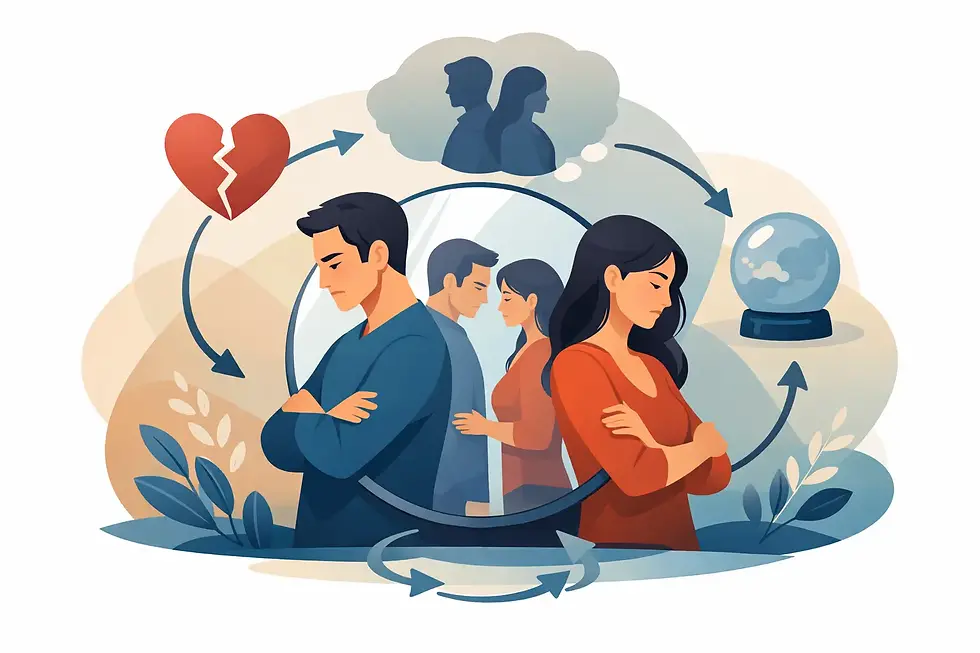
Reassurance from a partner can provide temporary relief. But if it is needed over and over again, a vicious cycle often ensues: doubt arises, verification or confirmation is sought, momentary relief comes, and then the doubt returns stronger. The relationship begins to be organized around managing jealousy instead of around connection, joy, and a shared life.
There, it helps to explore not only the partner's behavior, but also the deeper belief that is activated: " I don't deserve to be chosen ," "they will leave me as soon as they meet someone better," or "if I don't control myself, I will get hurt." These beliefs can be changed gradually, through systematic work with your thoughts, reactions, and relationships.
Individual work can help when jealousy seems to recur in different relationships. Couples therapy can be helpful when you both want to understand the cycle of conflict, restore trust, and build clearer agreements. Research shows that the quality of communication and the ability to manage conflict are closely related to relationship stability and satisfaction (Overall & McNulty, 2017).
Jealousy doesn't have to be the driver of your relationship. It can be a signal to look honestly at what you fear, what you need, and how you want to love without losing yourself or the other person.
Academic references
Beck, JS (2011). Cognitive behavior therapy: Basics and beyond (2nd ed.). Guilford Press.
Guerrero, LK, & Andersen, PA (1998). The dark side of jealousy and envy: Desire, delusion, desperation, and destructive communication. In BH Spitzberg & WR Cupach (Eds.), The dark side of close relationships (pp. 33-70). Lawrence Erlbaum Associates.
Linehan, MM (2015). DBT skills training manual (2nd ed.). Guilford Press.
Mikulincer, M., & Shaver, PR (2016). Attachment in adulthood: Structure, dynamics, and change (2nd ed.). Guilford Press.
Overall, NC, & McNulty, JK (2017). What type of communication during conflict is beneficial for intimate relationships? Current Opinion in Psychology, 13 , 1-5.