Are you more jealous than ever? Is Instagram to blame?
If you recognize yourself in the thought “are you more jealous than ever? It’s not your partner – it’s Instagram,” it doesn’t mean you’re being unreasonable, overreacting, or that your relationship is doomed. Often, jealousy doesn’t start with a specific message or like. It’s fueled by the constant exposure to images, bodies, outings, and seemingly perfect lives that Instagram places before us. The purpose of this article is to help you understand how the platform can influence insecurity and comparison, when there’s real cause for concern, and how you can respond without scrutiny, blame, or rejection.
Are you more jealous than ever? How does Instagram affect you?
Instagram doesn't create jealousy on its own. But it can act as a magnifying glass for an already sensitive area: the fear that you're not enough, that you can be replaced, or that you don't know the whole truth.
In the past, a doubt might linger in your mind for a while. Now it can take visual form in seconds: who liked it, who appeared in stories, which old photo was commented on, which new person was followed. The brain doesn't just take in information. It tries to interpret it. And when there's insecurity, it often interprets the gaps with the most threatening scenario.
Social comparison is a key mechanism here. You see a curated image of someone else and, almost unconsciously, compare it to moments of doubt, fatigue, or distance in your own relationship. Research has linked more frequent social media use, and particularly passive viewing, to more negative comparisons and lower self-esteem (Vogel et al., 2014).
So it's not just what your partner does online. It's also what happens inside you when you watch, assume, and compare.
The trap of "research"
When you're feeling jealous, checking can seem like a solution. You look back at someone's profile, analyze the number of likes, notice if your partner is online, or go back to old posts to find something that will reassure you.
Usually, though, the relief is short-lived. Then a new doubt appears: “Why did he only like this photo?”, “Why didn’t he tell me?”, “Did he delete something?” Controlling behavior may temporarily reduce anxiety, but in the long run it trains the mind to demand more and more certainty.
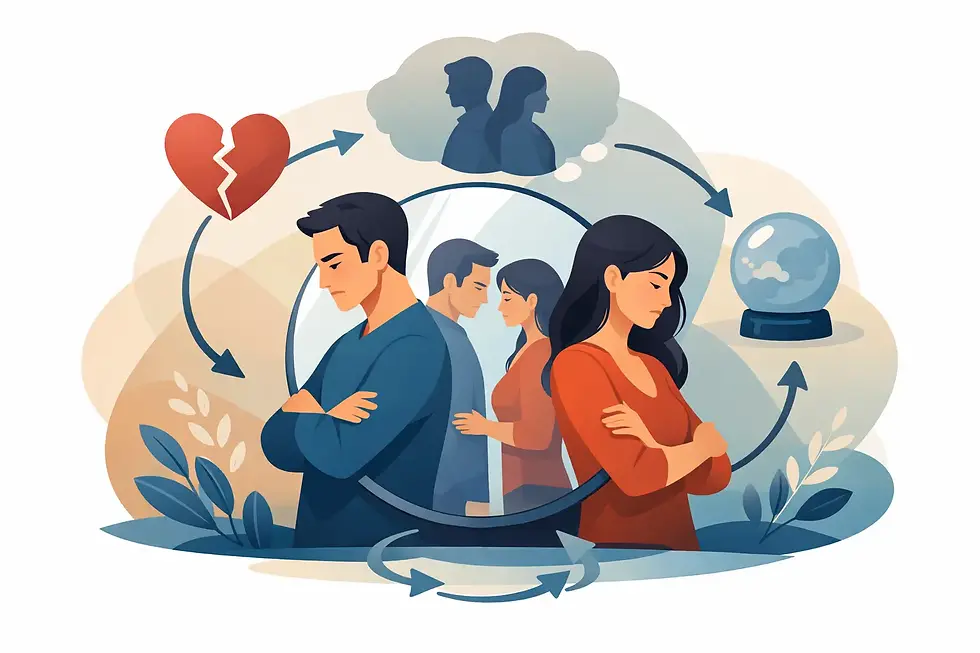
This process is not about a lack of character. It is about a cycle: activation, control, brief relief, reactivation. Studies of Facebook use have shown that passively following others is often associated with more negative emotion, precisely because it reinforces comparison without providing meaningful connection (Kross et al., 2013). The same pattern can occur on Instagram, especially when scrolling occurs late at night, after an argument, or during a period of personal stress.
Jealousy is not always a sign that you "know something"
Strong emotion often feels like proof. “Since I feel it so strongly, it must mean something.” In the cognitive-behavioral approach, however, we separate the emotion from the fact. Jealousy is a message that something threatens or hurts you. It is not automatically a reliable predictor of what the other person will do.
This doesn't mean you should ignore your intuition or justify behaviors that hurt you. If there are repeated lies, broken agreements, hiding things, or a condescending attitude, then you need to take the relationship seriously. The difference is that it's worth relying on specific behaviors and not solely on digital traces that can have dozens of interpretations.
Before you speak, separate facts and stories
Try writing down what upset you in two columns. In the first, put only what can be described as a camera: “I saw a comment with a heart,” “followed an old acquaintance,” “didn’t reply for three hours.” In the second, put the story your mind created: “flirts,” “compares me,” “doesn’t love me as much as before.”
The second column is not useless. That's where your fear lies, and it deserves respect. It just doesn't need to be taken for granted. Ask yourself: "What evidence supports this thought? What evidence doesn't fit with it? Is there a more balanced explanation?"
This little pause doesn't make the emotion go away. But it does reduce the likelihood that you'll start a conversation from a position of blame. And that significantly changes its outcome.
How to open the conversation without being interrogated
The phrase “Why did you like it?” usually invites defense. The phrase “When I often see interactions with this person, I find myself feeling insecure and I want to talk about it” leaves more room for connection.
Talk about your experience, not the intent you attribute to the other person. Instead of “You’re doing this to make me jealous,” you can say “When this happens, it’s hard for me not to make up scenarios.” That’s not giving in. It’s more clearly communicating what you need.
It is equally important to listen to what using Instagram means to your partner. For some, it is work, social contact or a habit. For others, it is a field of affirmation. Agreements in a couple are not the same for everyone. What is valuable is that they are mutual, clear and enforceable, not arising from fear or control.
A practical test for the next seven days
If you want to see if Instagram is making you jealous, don't rush into making big decisions. Do a little experiment for a week. Notice when you open the app: after loneliness, boredom, tension at work, or a difficult moment with your partner? Write down, in a word, how you feel before and after.
For these seven days, set two specific boundaries: avoid checking profiles that trigger you, and don't open Instagram in the last hour before bed. If the urge arises, wait ten minutes before acting. During this time, name the feeling: "Right now I feel fear and jealousy, not certainty."
The logic is not to ban yourself from the platform. It is to reclaim choice. Research shows that the way you use social media and your emotional investment in it are more related to distress than the simple duration of use (Frison & Eggermont, 2017). For some people, more mindful use is enough. For others, more distance from specific accounts or patterns of following is needed.
When does jealousy need more care?
It's worth seeking support when jealousy takes up a large part of your day, leads to repetitive checking, creates frequent arguments, or makes you withdraw from friends, work, and interests. Also, when you recognize that the same pattern has appeared in more than one relationship, it may not be just the current situation that's the issue.
Individual work with CBT can help you identify thoughts that fuel the threat, reduce controlling behaviors, and build greater tolerance for uncertainty. In couples therapy, the goal isn’t to decide who’s right about a like. It’s to create boundaries, trust, and a way of talking that doesn’t turn every digital stimulus into a crisis.
Instagram may add noise to your relationship, but it doesn't have to decide your worth or how you connect with your partner. The next time you feel the urge to check, try asking yourself first: "What do I really need right now - an update or a little reassurance?"
Bibliographic references
Frison, E., & Eggermont, S. (2017). Browsing, posting, and liking on Instagram: The reciprocal relationships between different types of Instagram use and adolescents' depressed mood. Cyberpsychology, Behavior, and Social Networking, 20 (10), 603-609.
Kross, E., Verduyn, P., Demiralp, E., Park, J., Lee, DS, Lin, N., Shablack, H., Jonides, J., & Ybarra, O. (2013). Facebook use predicts declines in subjective well-being in young adults. PLoS ONE, 8 (8), e69841.
Vogel, EA, Rose, JP, Roberts, LR, & Eckles, K. (2014). Social comparison, social media, and self-esteem. Psychology of Popular Media Culture, 3 (4), 206-222.