A practical guide to managing social anxiety
A presentation at work, a table with people you don’t know, or even a simple phone call can seem disproportionately difficult when you have social anxiety. It’s not a lack of ability or “sociability,” but a cycle of intense self-observation, fear of negative judgment, and avoidance that often limits your daily life. This guide to managing social anxiety aims to help you recognize this cycle and try practical, gradual ways to change. You’ll see how thoughts, physical reactions, and behaviors are connected, how to approach difficult social situations without pushing yourself too hard, and when working with a therapist can provide more solid support.
How social anxiety works
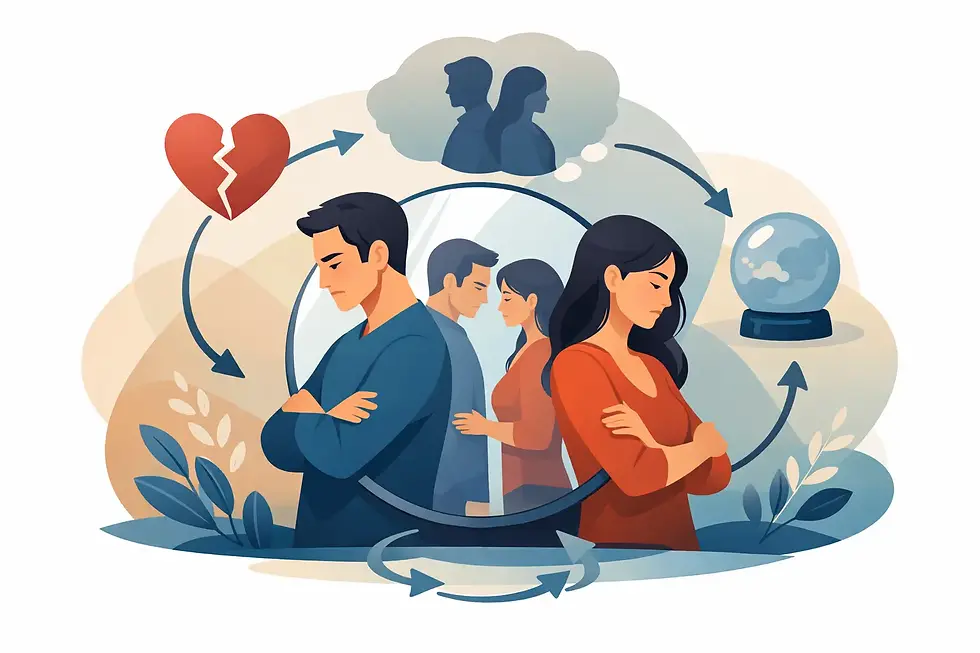
Social anxiety doesn't usually only occur at the moment of a social interaction. It can start days before, with thoughts like "I'm going to mess up," "I'm going to look inadequate," or "They'll know I'm nervous." During the situation, your attention is intensely inward: you notice the tone of your voice, a blush, a trembling hand, or a pause in conversation. Then, you may replay every detail in your mind , searching for what went "wrong."
This process makes the threat seem greater than it is. According to the cognitive model of Clark and Wells (1995), the negative image that someone forms of themselves in a social situation can maintain anxiety, even when others do not evaluate them in the same harsh way.
Avoidance offers momentary relief: you don’t go to the meeting, you don’t ask the question in the meeting, you don’t open up a conversation. But it unwittingly reinforces the message that the situation was indeed dangerous. Management doesn’t mean making all embarrassment disappear. It means being able to act on what’s valuable to you, even when there’s stress.
Social Anxiety Management Guide: Start with the Pattern
Before you change anything, you need to see clearly what's going on. For a week or two, briefly jot down the social moments that made you feel uncomfortable. You don't need a detailed diary. Just note the situation, the underlying thought, the level of anxiety on a scale of 0 to 10, and what you did.
For example: “Meeting with boss - thought: he will consider my idea naive - anxiety 8/10 - I didn't speak up”. Or: “Call with client - thought: if I pause, I will look unprepared - anxiety 7/10 - I was constantly reading from notes”.
The goal is not to judge yourself for your reaction. It is to separate three things: what you fear will happen, what you are doing to protect yourself, and what the actual outcome is. Often, anxiety is maintained by safety behaviors, such as avoiding eye contact, over-preparing, constantly seeking reassurance, or trying not to show any embarrassment. They may offer control in the moment, but they don’t leave room for you to realize that you can do without them.
Control the thought, without trying to "extinguish" it.
The useful question is not “how do I stop thinking negatively?” Thoughts do not obey orders. It is more helpful to consider whether the thought is a prediction or an event.
If you're thinking, "Everyone will know I'm stressed," ask: What evidence supports this? Is there another, more balanced interpretation? If someone notices a little awkwardness, does that mean they're rejecting me? A realistic alternative might be, "I may feel stressed and it may show a little, but that doesn't determine my worth or competence."
You don’t need to convince yourself that everything will be perfect. Overly positive thinking often rings false when stress is high. Look for a thought that is reliable enough to allow you to take the next small step. The cognitive behavioral approach places particular emphasis on this connection between the interpretation of a situation and the behavior that follows (Hofmann, 2007).
Gradual exposure is practice, not a test.
Avoidance is most effectively reduced when it is replaced by small, repeated encounters with the feared object. This is called gradual exposure. It doesn't mean suddenly putting yourself in the most challenging scenario, nor forcing yourself to feel comfortable. It means building experiences that show you can tolerate the discomfort and keep going.
Create a personal scale from easiest to hardest. For one person, it might start with a “good morning” to a neighbor, continue with a quick question to a colleague, and later with expressing an opinion in a team meeting. For another, the first step might be turning on the camera in a short online meeting with colleagues abroad.
Repeat the same step several times. At first, anxiety may increase - this is not a failure. Observe whether it changes over time and, importantly, what actually happens compared to what you predicted. Exposure works best when it involves new learning experiences, not when it is done as a test to see if anxiety will immediately disappear (Craske et al., 2014).
Reduce one safety behavior at a time
If you're talking too fast to finish the conversation, try taking a natural pause. If you've memorized every phrase before a presentation, stick to just a few key words. If you consistently avoid eye contact, try two or three seconds of eye contact, without making it a rigid rule.
Changing just one behavior is enough to get you started. If you try to change your voice, your attitude, your thoughts, and the content of the conversation all at once, you're likely to increase the pressure. Progress in social anxiety is often less dramatic and more substantive: staying five minutes longer, asking a question, returning to a contact you previously would have avoided.
What to do when stress rises
Physical reactions, such as a rapid heartbeat, tension, or dry mouth, are unpleasant but not proof that something is wrong. If you try to control every sensation, you often make it more intense. Instead, deliberately turn your attention outside yourself: listen to the other person's words, observe your surroundings, look for information that really interests you.
A slow exhalation can help reduce physical tension. But keep the goal realistic: it's not a technique to instantly make stress disappear, but a way to create a little more space before you react. You can also have a simple guiding phrase, like "I can be stressed and still be present."
In professional relationships, it helps to shift the focus from personal evaluation to contribution. Instead of “I need to look smart,” try “I want to understand the issue and add a helpful observation.” This small shift can be especially important in highly competitive or hierarchical environments.
When is it worth asking for support?
It is worth talking to a psychotherapist when avoidance affects relationships, work, studies or choices you would like to make. Also, when self-criticism after every social contact becomes exhausting or when the above exercises seem impossible to implement on your own.
Psychotherapy can provide a safe, concrete framework for understanding your personal fears, planning presentations at a pace that suits you, and working through your harsh inner criticism. Cognitive behavioral therapy has significant research support for reducing social anxiety difficulties (Mayo-Wilson et al., 2014). However, the plan is not the same for everyone: someone who avoids social outings has different needs than someone who has difficulty expressing themselves in front of a group.
Change doesn't require you to become the most outgoing person in the room. It just requires you to start taking a little more space in the life you want, with small, repeated actions and the necessary understanding of yourself.
Bibliographic references
Clark, DM, & Wells, A. (1995). A cognitive model of social phobia. In RG Heimberg, MR Liebowitz, DA Hope, & FR Schneier (Eds.), Social phobia: Diagnosis, assessment, and treatment (pp. 69-93). Guilford Press.
Craske, MG, Treanor, M., Conway, CC, Zbozinek, T., & Vervliet, B. (2014). Maximizing exposure therapy: An inhibitory learning approach. Behavior Research and Therapy, 58 , 10-23.
Hofmann, SG (2007). Cognitive factors that maintain social anxiety disorder: A comprehensive model and its treatment implications. Cognitive Behavior Therapy, 36 (4), 193-209.
Mayo-Wilson, E., Dias, S., Mavranezouli, I., Kew, K., Clark, DM, Ades, AE, & Pilling, S. (2014). Psychological and pharmacological interventions for social anxiety disorder in adults: A systematic review and network meta-analysis. The Lancet Psychiatry, 1 (5), 368-376.